
Few cinematic environments are as inherently dramatic as the penitentiary. Stripped of privacy, freedom, and civilian identity, inmates are thrust into high-pressure social microcosms governed by strict internal hierarchies, bureaucratic cruelty, and the eternal ache for liberty.
Yet films in prison are rarely just about concrete walls and steel bars. Across film history, the greatest prison cinema has served as a canvas for profound meditations on human resilience, anti-establishment rebellion, brotherhood, and even sublime comedy. Whether exploring the patient mechanics of a tunnel escape or turning a cellblock into a pink-striped musical confection, filmmakers have continually rediscovered the poetry of confinement.
Here is the definitive critical ranking of the 15 greatest prison films of all time.
15. Stir Crazy (1980)
- Director: Sidney Poitier
- Starring: Gene Wilder, Richard Pryor, Georg Stanford Brown, JoBeth Williams
- The Confinement Dynamic: Mismatched urban neurotics navigating a maximum-security madhouse
Directed by the legendary Sidney Poitier, Stir Crazy made box office history by becoming the first film directed by an African American to gross over $100 million. But more importantly, it remains the high-water mark of Gene Wilder and Richard Pryor’s electric comic chemistry.
Framed for a bank robbery while working as singing woodpeckers in Manhattan, playwright Skip Donahue (Wilder) and aspiring actor Harry Monroe (Pryor) receive 125-year sentences in a grueling Arizona penitentiary. Poitier allows Pryor’s panicked street swagger and Wilder’s sunny, delusional optimism to bounce off terrifying convicts and prison rodeos. Wilder hanging suspended in medieval torture ropes while politely remarking, “It’s doing wonders for my back,” is slapstick perfection.
14. Paddington 2 (2017)
- Director: Paul King
- Starring: Hugh Bonneville, Sally Hawkins, Brendan Gleeson, Hugh Grant
- The Confinement Dynamic: Unconditional kindness transforming a Victorian fortress of hard labor
It may seem audacious to place a family adventure about a polite Peruvian bear alongside grim cinematic masterpieces, but Paddington 2 features one of the most inventive prison sequences ever filmed. Framed for the theft of an antique pop-up book by Hugh Grant’s narcissistic actor, Paddington is sentenced to ten years in a grim Victorian prison.
Drawing obvious inspiration from the symmetrical staging of Wes Anderson films and the silent slapstick of Charlie Chaplin, director Paul King transforms prison drudgery into joy. By accidentally washing the inmates’ gray uniforms with a stray red sock, Paddington turns the entire prison pink. When he softens terrifying prison chef “Knuckles” McGinty (Brendan Gleeson) with a handmade marmalade sandwich, the institution becomes a pastel paradise of patisserie and mutual rehabilitation.
13. O Brother, Where Art Thou? (2000)
- Director: Joel & Ethan Coen
- Starring: George Clooney, John Turturro, Tim Blake Nelson, John Goodman
- The Confinement Dynamic: Chain-gang escapees navigating a mythological American South
Ranked among the high-water marks of our best Coen Brothers movies, the film opens with the rhythmic clang of pickaxes and the haunting chain-gang spiritual “Po’ Lazarus,” beginning behind bars before spilling onto the Mississippi backroads. Ulysses Everett McGill (George Clooney) and his chained companions Pete (John Turturro) and Delmar (Tim Blake Nelson) break free from a rural chain gang in search of buried treasure.
While the film operates as a picaresque road comedy, the shadow of penal servitude looms over every encounter. Everett’s desperate obsession with pomade, the ever-present threat of the bloodhounds, and the sinister, sunglasses-wearing sheriff give the film’s folk-music buoyancy a sharp edge of fugitive paranoia.
12. Bronson (2008)
- Director: Nicolas Winding Refn
- Starring: Tom Hardy, Matt King, James Lance
- The Confinement Dynamic: Prison as a theatrical stage for a one-man opera of violence
Before Drive, Danish auteur Nicolas Winding Refn directed this stylized, surrealist biographical black comedy about Michael Peterson—better known by his ring name Charles Bronson—frequently cited as the “most violent prisoner in Britain.”
Anchored by Tom Hardy in a ferocious, star-making physical performance, Bronson treats the British penal system not as a place of correction, but as a proscenium stage. Hardy’s Bronson narrates his life in clown makeup before a theatrical audience, stripping naked, coating himself in butter, and brawling with riot guards to classical music. It is a hallucinatory study of an inmate who found absolute freedom only while locked in a cage.
11. A Prophet (Un Prophète, 2009)
- Director: Jacques Audiard
- Starring: Tahar Rahim, Niels Arestrup, Adel Bencherif
- The Confinement Dynamic: A vulnerable young inmate learning ruthless underworld survival
Jacques Audiard’s gritty French crime epic is the modern gold standard of realistic prison sociology. Tahar Rahim stars as Malik El Djebena, an illiterate 19-year-old Algerian orphan sentenced to six years in a brutal French penitentiary.
Cornered by the prison’s ruling Corsican mafia boss (a terrifying Niels Arestrup), Malik is coerced into committing a gruesome murder. Rather than succumbing to the brutality, Malik uses his position as an errand boy to observe, learn Corsican, forge alliances with Muslim factions, and master economic smuggling. Audiard avoids Hollywood melodrama, showing how modern penal institutions act as graduate universities for criminal empires.
10. Midnight Express (1978)
- Director: Alan Parker
- Starring: Brad Davis, Randy Quaid, John Hurt, Irene Miracle
- The Confinement Dynamic: An American tourist descending into the sensory nightmare of foreign incarceration
Based on the real-life memoir of Billy Hayes and adapted by Oliver Stone (who won an Academy Award for Best Adapted Screenplay), Midnight Express remains one of cinema’s most visceral experiences of claustrophobia and institutional despair.
Arrested at an Istanbul airport for attempting to smuggle two kilos of hashish, Hayes (Brad Davis) is plunged into Sagmalcilar Prison, where he faces corrupt guards, sadism, and arbitrary sentence extensions. Driven by Giorgio Moroder’s revolutionary electronic synth score, Alan Parker creates an unbearable sense of psychological degradation, culminating in Hayes’ desperate realization that his only escape is “the midnight express”—a train that never stops.
9. The Great Escape (1963)
- Director: John Sturges
- Starring: Steve McQueen, James Garner, Richard Attenborough, Charles Bronson
- The Confinement Dynamic: Allied officers turning a Nazi POW camp into an engineering war room
Based on Paul Brickhill’s account of the mass escape from Stalag Luft III in 1944, John Sturges’ epic WWII masterpiece is the ultimate celebration of Allied ingenuity and defiance. Designed by the Germans as an “escape-proof” camp to hold serial breakout artists, the prisoners view escape not merely as personal freedom, but as a military duty to tie down enemy resources.
Featuring an iconic ensemble—Richard Attenborough as the mastermind “Big X,” James Garner as the slick scrounger, Charles Bronson as the claustrophobic tunnel king, and Steve McQueen as the baseball-bouncing “Cooler King”—the film balances thrilling procedural logistics (digging tunnels “Tom,” “Dick,” and “Harry”) with unbearable suspense. McQueen’s legendary motorcycle jump across the barbed-wire fences remains one of Hollywood’s defining images of rebellion.
8. Papillon (1973)
- Director: Franklin J. Schaffner
- Starring: Steve McQueen, Dustin Hoffman, Victor Jory, Don Gordon
- The Confinement Dynamic: Unyielding willpower surviving the living hell of French Guiana
Adapted from Henri Charrière’s best-selling autobiography, Papillon is a grueling, magnificent epic of endurance. Steve McQueen stars as “Papillon,” a Parisian safecracker wrongly convicted of murder and shipped to the notorious penal colony of French Guiana, while Dustin Hoffman plays Louis Dega, a frail, wealthy counterfeiter who finances their escape attempts.
Franklin J. Schaffner pulls no punches in capturing the rot of the penal colony. McQueen spending two years in total solitary confinement—eating roaches in the dark, pacing across his five-foot cell, yet refusing to betray Dega—is a staggering physical performance. The climactic leap from the towering sea cliffs of Devil’s Island onto a sack of coconuts is a transcendent cinematic triumph.
7. The Green Mile (1999)
- Director: Frank Darabont
- Starring: Tom Hanks, Michael Clarke Duncan, David Morse, Sam Rockwell
- The Confinement Dynamic: Compassionate death-row guards encountering a miraculous force of grace
Adapted from Stephen King’s serialized novel, director Frank Darabont followed his triumph on Shawshank with another emotionally shattering prison tale. Set on Cold Mountain Penitentiary’s death row (“The Green Mile”) in 1935 Louisiana, the film follows head guard Paul Edgecomb (Tom Hanks) and his gentle colleagues as they oversee John Coffey (Michael Clarke Duncan), a gentle, giant Black man gifted with supernatural healing powers who has been wrongly sentenced to death.
Much like the humanistic literary horror seen in our ranking of every Mike Flanagan movie and TV show, The Green Mile uses confinement as a crucible for moral grace. Duncan earned an Oscar nomination for his heartbreaking, soul-stirring turn, and the film’s examination of human cruelty and redemption leaves few dry eyes.
6. In the Name of the Father (1993)
- Director: Jim Sheridan
- Starring: Daniel Day-Lewis, Pete Postlethwaite, Emma Thompson
- The Confinement Dynamic: A fractured father-son bond forged in the crucible of wrongful imprisonment
Jim Sheridan’s searing drama recounts the true story of the Guildford Four—four innocent Northern Irish youths coerced into confessing to an IRA pub bombing in 1974. Gerry Conlon (Daniel Day-Lewis in a tour de force) and his frail, devout father Giuseppe (Pete Postlethwaite) are sentenced to life imprisonment in the same English penitentiary.
The heart of the film is not just the legal crusade waged by crusading attorney Gareth Peirce (Emma Thompson), but the intimate evolution between father and son behind bars. Day-Lewis captures Gerry’s transition from an aimless, resentful youth into a ferocious fighter for truth, inspired by the quiet, saintly dignity of his father.
5. Escape from Alcatraz (1979)
- Director: Don Siegel
- Starring: Clint Eastwood, Patrick McGoohan, Fred Ward, Roberts Blossom
- The Confinement Dynamic: Cold, meticulous engineering chipping away at America’s ultimate fortress
The fifth and final collaboration between director Don Siegel and Clint Eastwood, Escape from Alcatraz is a textbook lesson in minimalist cinematic suspense. Recounting the legendary June 1962 breakout of bank robber Frank Morris and brothers John and Clarence Anglin from “The Rock,” the film strips away extraneous dialogue in favor of tangible physical labor.
Eastwood plays Morris with icy, watchful intelligence, clashing with the tyrannical, rose-tending warden played with sinister restraint by Patrick McGoohan. Siegel makes the audience feel every millimeter of plaster scraped away by nail clippers, the smell of papier-mâché dummy heads, and the icy, black currents of San Francisco Bay.
4. Le Trou (The Hole, 1960)
- Director: Jacques Becker
- Starring: Michel Constantin, Jean Keraudy, Philippe Leroy, Raymond Meunier
- The Confinement Dynamic: The raw, breathless mechanics of five men chipping through Parisian bedrock
Jacques Becker’s final film, released shortly after his death in 1960, is widely considered by international filmmakers to be the purest prison escape film ever photographed. Set inside Paris’s La Santé Prison in 1947, four seasoned cellmates planning a breakout find a young newcomer transferred into their cell, forcing them to decide whether to trust him with their lives.
Becker films the physical reality of the escape in mesmerizing real-time detail. There is no musical score; the soundtrack consists entirely of metal grinding on stone, cardboard cartons crumbling, and the rhythmic thud of an iron bedpost being used as a chisel. Becker cast non-professional actors—including Jean Keraudy, an actual participant in the real-life 1947 breakout—giving the film unmatched authenticity and nerve-shredding suspense.
3. La Grande Illusion (Grand Illusion, 1937)
- Director: Jean Renoir
- Starring: Jean Gabin, Marcel Dalio, Pierre Fresnay, Erich von Stroheim
- The Confinement Dynamic: Aristocratic chivalry crumbling before the modern machine age in a WWI fortress
Jean Renoir’s masterpiece is one of the foundational triumphs of world cinema—and the very first foreign-language film ever nominated for the Academy Award for Best Picture. Set in a series of German prisoner-of-war camps during World War I, the film tracks French officers from disparate social classes thrown together behind enemy lines.
The film reaches its poetic apex in the mountain fortress of Wintersborn, presided over by the stiff-necked, neck-braced German aristocrat Captain von Rauffenstein (Erich von Stroheim). Renoir’s genius is his humane realization that the real prison walls are not barbed wire, but the artificial barriers of class, nationality, and war. It remains a timeless, deeply moving anti-war statement.
2. Cool Hand Luke (1967)
- Director: Stuart Rosenberg
- Starring: Paul Newman, George Kennedy, Strother Martin, Jo Van Fleet
- The Confinement Dynamic: An indomitable, smiling spirit that cannot be broken by a Southern chain gang
“What we’ve got here is failure to communicate.”
Stuart Rosenberg’s 1967 masterpiece gave cinema its ultimate anti-authoritarian folk hero in Luke Jackson (Paul Newman). Sentenced to two years on a rural Florida chain gang for cutting the heads off parking meters while drunk, Luke refuses to yield to the brutal regimentation of the Captain (Strother Martin) or the chains around his ankles.
Newman’s performance is radiant with effortless cool and tragic stubbornness. From bluffing his way through a poker game with nothing (“sometimes nothing can be a real cool hand”) to eating fifty hard-boiled eggs on a bet, Luke becomes a messianic figure of hope for his fellow inmates. George Kennedy won an Academy Award for his turn as cellblock leader Dragline, and Luke’s defiant smile in the face of inevitable destruction remains an immortal symbol of freedom.
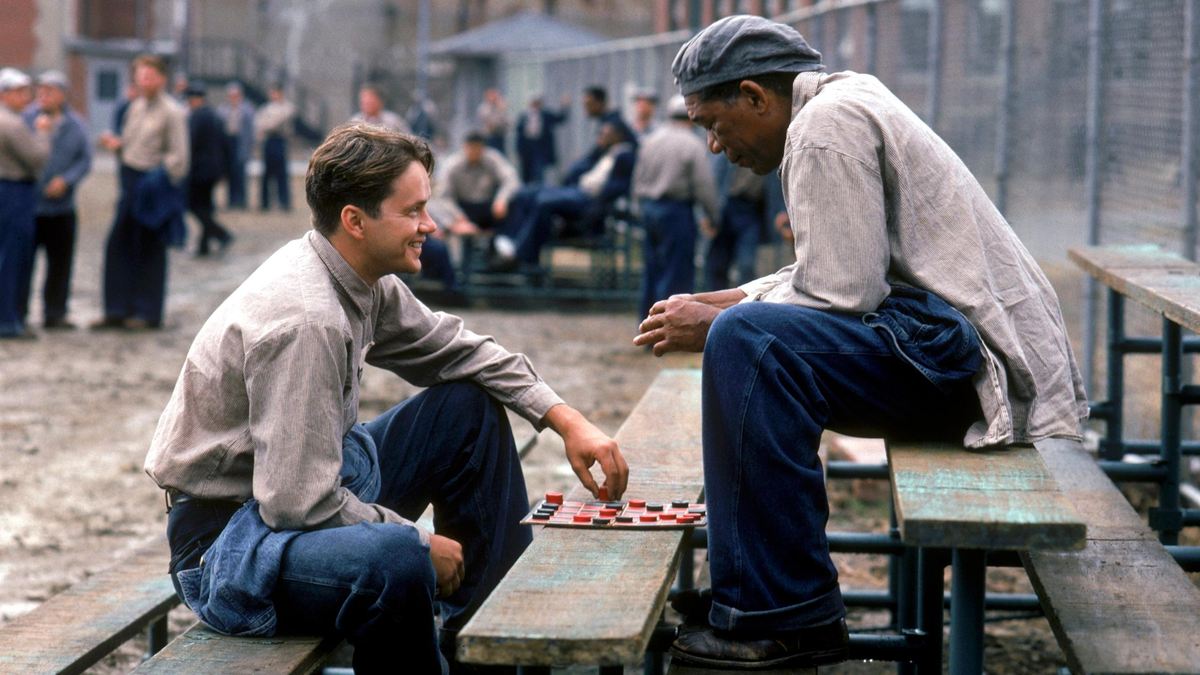
1. The Shawshank Redemption (1994)
- Director: Frank Darabont
- Starring: Tim Robbins, Morgan Freeman, Bob Gunton, William Sadler, Clancy Brown
- The Confinement Dynamic: Decades of patient stoicism, friendship, and the invincible triumph of hope
There was never any question. Frank Darabont’s adaptation of Stephen King’s novella Rita Hayworth and Shawshank Redemption is not merely the greatest prison film ever made; it is consistently ranked by audiences across the globe as one of the best Stephen King movies and most beloved cinematic stories of all time.
Wrongly convicted in 1947 of the murder of his wife and her lover, quiet New England banker Andy Dufresne (Tim Robbins) arrives at Shawshank State Penitentiary, where he befriends Red (Morgan Freeman in an all-time great voiceover and performance), the prison’s contraband smuggler. Over nearly two decades under the corrupt reign of Warden Norton (Bob Gunton), Andy uses his intellect, patience, and a tiny rock hammer to survive.
From sharing cold suds on the factory roof to playing Mozart’s The Marriage of Figaro over the prison loudspeakers, Shawshank understands that human dignity is unbreakable so long as one holds onto hope: “Remember Red, hope is a good thing, maybe the best of things, and no good thing ever dies.”
Andy crawling through five hundred yards of foulness to emerge into the cleansing thunderstorm is cinema’s definitive baptism of freedom.
Why Prison Cinema Endures
The ultimate appeal of the prison film subgenre lies in its universality. Every human being understands confinement—whether trapped by economic hardship, routine, or personal grief.
By stripping life down to its absolute essentials, the best films in prison force their characters, and by extension the audience, to confront the fundamental questions of existence: What is freedom worth? How do we preserve our humanity when everything has been taken away? And when the door finally opens, who will we choose to be?