
No contemporary American director has created a visual and comedic vocabulary as instantly recognizable, meticulously engineered, and fiercely debated as Wes Anderson.
To casual observers, Anderson’s cinema is often reduced to an aesthetic checklist: Futura bold typography, whip-pans, pastel color palettes, dollhouse dioramas, and characters staring straight into the lens with symmetrical deadpan expressions.
Yet to dismiss his filmography as mere hipster ornamentation is to miss the beating heart of his work.
Every Wes Anderson film is fundamentally a story about grief, failed patriarchs, and the fragile chosen families we construct to survive disappointment.
Anderson’s genius lies in using hyper-stylized geometric order as a coping mechanism against emotional chaos. His characters dress in matching tracksuits, speak in crisp mid-Atlantic cadences, and curate eccentric collections precisely because their internal lives are disintegrating.
Much like the structural stillness we analyzed in the anatomy of deadpan cringe and the neurotic vulnerability pioneered in the films of Albert Brooks, Anderson’s comedy works because his characters treat their absurd obsessions with deadly, Shakespearean seriousness.
Here is the definitive critical ranking of every Wes Anderson film, evaluated by screenwriting wit, emotional resonance, and directorial mastery.
1. The Grand Budapest Hotel (2014)
The Story: In the fictional pre-war European republic of Zubrowka, legendary concierge Monsieur Gustave H. and his loyal lobby boy Zero Moustafa become entangled in the theft of a priceless Renaissance painting and a battle for a family fortune.
“You see, there are still faint glimmers of civilization left in this barbaric slaughterhouse that was once known as humanity. Indeed that’s what we provide in our own modest, humble, insignificant… shit, what was that?”
The Grand Budapest Hotel represents the absolute zenith of Anderson’s cinema. Here, his visual precision—shifting between three distinct aspect ratios (1.37:1, 1.85:1, and 2.35:1) to reflect different historical epochs—serves a profound political and emotional narrative inspired by Austrian author Stefan Zweig.
At the center of this pink confectionery world is Ralph Fiennes’s career-best comic performance as Monsieur Gustave H. Dousing himself in “L’Air de Panache,” reciting romantic poetry mid-prison break, and fiercely defending his refugee lobby boy against fascist border guards, Gustave embodies the tragedy of elegance vanishing before a brutal world. Balancing breathless farce against the encroaching shadow of totalitarianism, it is Anderson’s crowning artistic triumph.
2. The Royal Tenenbaums (2001)
The Story: An estranged, deceitful patriarch feigns terminal stomach cancer to worm his way back into the lives of his three former child-prodigy adult children living in a crumbling Manhattan mansion.
“I’ve always been considered an asshole, for about as long as I can remember. That’s just my style.”
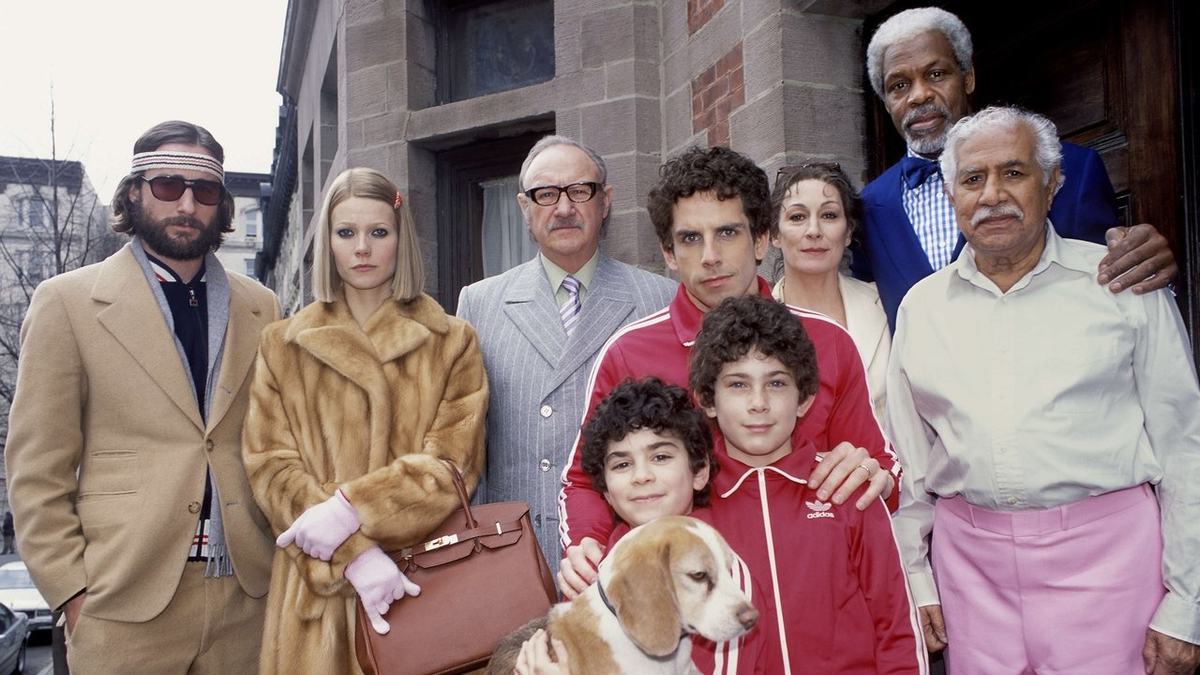
If Rushmore established Anderson’s voice, The Royal Tenenbaums codified his universe. Set inside an idealized, storybook Manhattan, the film is a masterclass in ensemble character economy. Every child prodigy’s adult failure is externalized through iconic costume design: Ben Stiller’s Chas trapped in red Adidas tracksuits after the death of his wife; Gwyneth Paltrow’s Margot chain-smoking in a fur coat with a wooden finger; Luke Wilson’s Richie wearing tennis sweatbands long after his center-court breakdown.
Gene Hackman gave one of the greatest performances of his storied career as Royal Tenenbaum—a charming, unapologetic rogue whose selfish schemes gradually yield to genuine paternal sorrow. Set to the bittersweet needle drops of Nico, The Clash, and Elliott Smith, it remains the definitive cinematic study of eccentric family dysfunction.
3. Rushmore (1998)
The Story: Max Fischer, an ambitious, academically disastrous private school sophomore, forms an unlikely friendship with a depressed industrialist tycoon while competing with him for the affections of a first-grade teacher.
“I saved Latin. What did you ever do?”
Rushmore is the foundational text of modern American indie comedy. In Max Fischer, Anderson and co-writer Owen Wilson created one of cinema’s most enduring teenage anti-heroes: a barber’s son masquerading as an eccentric Renaissance man who directs pyrotechnic stage adaptations of Serpico while failing basic geometry.
More importantly, Rushmore launched the second act of Bill Murray’s legendary career. Shedding the manic energy of his 1980s studio comedies—a lineage we examined in our retrospective of Steve Martin and mid-century comedy icons—Murray played Herman Blume with mournful, deadpan quietude. The sequence where Blume tosses golf balls into his children’s swimming pool while nursing a whiskey redefined deadpan cinematic pathos for the next quarter-century.
4. Fantastic Mr. Fox (2009)
The Story: An urbane, newspaper-columnist fox succumbs to his primal animal instincts, raiding three industrial human farms and plunging his animal community into an all-out war for survival.
“If what I think is happening is happening… it better not be.”
When Anderson adapted Roald Dahl’s children’s classic using traditional stop-motion puppets animated on “twos,” purists wondered if his aesthetic would translate. The result was pure magic. The tactile textures—real animal fur blowing in artificial wind, corduroy suits, and cotton-ball smoke—proved to be the ideal physical canvas for Anderson’s dioramas.
George Clooney brings effortless golden-age swagger to Mr. Fox, while Meryl Streep provides warm maternal ballast. The script’s replacement of vulgar profanity with the word “cuss” (“Are you cussing with me?”) is an inspired comedic stroke, turning an animal caper into a poignant meditation on aging, wildness, and domestic compromise.
5. Moonrise Kingdom (2012)
The Story: In the summer of 1965 on a remote New England island, an orphaned Khaki Scout and an introverted young girl stage an elaborate elopement, prompting a frantic search by island authorities.
Set to the classical orchestral variations of Benjamin Britten, Moonrise Kingdom captures the urgent, solemn gravity of adolescent first love. Sam Shakusky and Suzy Bishop do not view their romance as childhood puppy love; they treat it with the life-or-death seriousness of a mutual escape pact.
Anderson populates New Penzance Island with an exceptional ensemble playing weary, regretful adults: Bruce Willis as a melancholy island police captain, Edward Norton as an earnest scoutmaster, and Bill Murray and Frances McDormand as unhappily married lawyers. The contrast between youthful romantic certainty and adult disillusionment gives the film immense emotional resonance.
6. The Life Aquatic with Steve Zissou (2004)
The Story: A washed-up oceanographer seeks vengeance against the mythical "Jaguar Shark" that ate his best friend, joined by a crew of red-capped misfits and a pilot who might be his son.
“I’m going to find it and I’m going to destroy it. I don’t know how yet. Possibly with dynamite.”
Initially misunderstood upon release, The Life Aquatic has steadily ascended to beloved cult status. As Steve Zissou, Bill Murray plays Jacques Cousteau as a vain, petty, aging showman confronting creative and biological obsolescence aboard the Belafonte.
Featuring stop-motion animated marine life created by Henry Selick and acoustic Portuguese David Bowie covers performed on deck by Seu Jorge, the film is Anderson’s most sonically and visually ambitious undertaking. The climactic encounter with the Jaguar Shark—where Zissou quietly asks, “I wonder if it remembers me?”—is one of the most heartbreaking sequences in his entire canon.
7. Bottle Rocket (1996)
The Story: Three ambitious yet utterly clueless suburban Texas friends attempt to launch an organized crime career through small-time bookstore and cold-storage heists.
Anderson’s feature debut—developed from a Sundance short with mentor James L. Brooks—remains his rawest, most energetic picture. Filmed on location across Dallas and Fort Worth, Bottle Rocket lacks the symmetrical dollhouse compositions of his later work, relying instead on loose, sun-drenched Texas charm.
Owen Wilson announced himself as a major screen presence as Dignan, a hyperactive dreamer who maps out a “75-year crime plan” in a spiral notebook. The sweetness and innocence of these would-be criminals captured Martin Scorsese’s admiration, who championed Anderson as the most exciting new American auteur of the decade.
8. The French Dispatch (2021)
The Story: An anthology bringing to life three distinct feature stories published in the farewell issue of an American weekly magazine based in the fictional French town of Ennui-sur-Blasé.
The French Dispatch is Anderson’s unabashed love letter to mid-century New Yorker journalism. Staged as a four-part anthology framed by Bill Murray’s beloved editor Arthur Howitzer Jr. (“No crying in my office”), the film is a dizzying, densely packed tribute to literary craftsmanship.
While the sheer density of detail can feel overwhelming, Jeffrey Wright’s performance as James Baldwin surrogate Roebuck Wright—narrating a culinary heist and musing on the loneliness of exile—anchors the film in profound literary melancholy.
9. Asteroid City (2023)
The Story: A grief-stricken war photographer brings his four children to an isolated desert Junior Stargazer convention in 1955, where an extraterrestrial visitor places the town under military quarantine.
“You can’t wake up if you don’t fall asleep.”
Framed as a black-and-white 1950s television broadcast documenting the staging of a stage play, Asteroid City is Anderson’s most philosophically complex reflection on art and grief. Jason Schwartzman plays Augie Steenbeck, a widower who cannot bring himself to tell his children that their mother has died.
When an alien briefly descends over the crater, the town is confronted with the incomprehensible vastness of the universe. Scarlett Johansson gives a luminous performance as an emotionally guarded film star, turning a desert quarantine into an existential dialogue about making art in the face of unknowable tragedy.
10. Isle of Dogs (2018)
The Story: In a retro-futuristic Japan, canine flu prompts a corrupt authoritarian mayor to banish all dogs to a desolate trash island, where a runaway boy arrives searching for his loyal companion.
Returning to stop-motion animation, Anderson created an astonishing visual tribute to Akira Kurosawa and Japanese graphic design. As Chief, a stray dog who insists he doesn’t fetch because he bites, Bryan Cranston delivers a gravelly, soulful vocal performance alongside an all-star pack featuring Edward Norton, Jeff Goldblum, and Bill Murray.
The film’s tactile junk sculptures, taiko drum score by Alexandre Desplat, and exquisite miniature framing showcase Anderson’s relentless formal ambition, even when dealing with dystopian political allegory.
11. The Darjeeling Limited (2007)
The Story: Three estranged brothers, still reeling from the death of their father, embark on a heavily scheduled "spiritual journey" across India aboard a luxury sleeper train.
Often considered the minor work in Anderson’s filmography, The Darjeeling Limited nonetheless contains moments of breathtaking visual and emotional beauty. Francis (Owen Wilson, wrapped in head bandages following a motorcycle crash), Peter (Adrien Brody, who also shines in our breakdown of the cast of Poker Face), and Jack (Jason Schwartzman) carry literal matched Louis Vuitton luggage representing their inherited family baggage.
When the brothers fail to save a local boy from drowning in a river, the film abruptly sheds its comedic whimsy for raw, devastating grief. The subsequent Indian funeral sequence—conducted in absolute silence set to the music of Satyajit Ray—remains one of the most poignant passages in Anderson’s body of work.
The Enduring Symmetry of Wes Anderson
To rank the films of Wes Anderson is to measure gradations of obsession. No other contemporary filmmaker has maintained such unyielding control over every button, teacup, and wallpaper pattern while consistently exploring the agonizing beauty of human connection.
Much like the deadpan workplace hierarchies seen across The Office cast and the idiosyncratic character craft of Actors of Silicon Valley, Anderson’s films endure because they remind us of an essential truth: our eccentricities, rituals, and neuroses are not defects. They are the intricate, handcrafted suits of armor we wear to keep from breaking apart.