
Cinema is a pact of voluntary deception. When the theater lights dim, audiences willingly surrender their skepticism, placing their trust in the director to guide them through an emotional labyrinth.
Yet the most thrilling cinematic experiences occur when that very trust is weaponized against us.
A truly great plot twist is not a cheap parlor trick or an unearned rug-pull designed simply to shock. In the hands of master screenwriters and directors, a legendary twist reframes the entire narrative architecture. It turns the final frame into a key that unlocks a completely different movie upon rewatch—transforming casual background details, throwaway lines of dialogue, and subtle costume choices into flashing neon clues that were staring us in the face the entire time.
From psychological thrillers and sci-fi mind-benders to devastating horrors, here is the definitive critical ranking of the 15 best movies with a twist of all time.
15. The Mist (2007)
- Director: Frank Darabont
- Starring: Thomas Jane, Marcia Gay Harden, Laurie Holden, Andre Braugher
- The Reframing: Survival extinguished three minutes too early
As we highlighted in our ranking of the best Stephen King movies, director Frank Darabont threw out King’s open-ended novella ending and engineered the most merciless, gut-wrenching climax in modern cinema history.
After escaping a grocery store besieged by extradimensional Lovecraftian horrors, David Drayton (Thomas Jane) and four passengers—including his eight-year-old son Billy—run out of gas in the desolate, mist-shrouded wasteland. With only four bullets remaining, David mercy-kills his companions to spare them from horrific monster deaths.
Seconds after stepping out into the fog to let the beasts consume him, the mist clears: a roaring convoy of U.S. military tanks and flamethrower rescue trucks rolls past. Had David waited three more minutes, everyone would have survived. It is a soul-shattering exploration of premature despair that Stephen King publicly admitted was far superior to his own ending.
14. Arrival (2016)
- Director: Denis Villeneuve
- Starring: Amy Adams, Jeremy Renner, Forest Whitaker, Michael Stuhlbarg
- The Reframing: The grief-stricken past is actually an unavoidable future
Based on Ted Chiang’s novella Story of Your Life, Denis Villeneuve’s cerebral sci-fi masterpiece opens with linguist Louise Banks (Amy Adams) mourning the death of her young daughter from a rare cancer. When twelve extraterrestrial spacecraft arrive on Earth, Louise is recruited to decipher the non-linear, circular logograms of the alien Heptapods.
The revelation is monumental: because the Heptapods perceive all points in time simultaneously, learning their language fundamentally rewires Louise’s brain (the Sapir-Whorf hypothesis). The tragic vignettes of her daughter are not flashbacks of a life she has already lost; they are flash-forwards of a daughter she has not yet conceived with fellow scientist Ian Donnelly (Jeremy Renner).
Knowing the agony, divorce, and heartbreak that await her, Louise chooses love anyway. It transforms a high-stakes alien first-contact procedural into an awe-inspiring philosophical meditation on free will and acceptance.
13. Primal Fear (1996)
- Director: Gregory Hoblit
- Starring: Richard Gere, Edward Norton, Laura Linney, John Mahoney
- The Reframing: The timid victim was the mastermind puppet master
In his sensational, Oscar-nominated film debut, Edward Norton plays Aaron Stampler, a stuttering, terrified nineteen-year-old Kentucky altar boy accused of brutally butchering the Archbishop of Chicago. Arrogant, spotlight-chasing defense attorney Martin Vail (Richard Gere) takes the case pro bono, convinced of Aaron’s pure innocence.
During psychiatric evaluations, a violent, psychopathic alternate personality named “Roy” emerges, leading Vail to successfully win a verdict of not guilty by reason of insanity.
In the film’s legendary holding-cell finale, Vail visits Aaron to deliver the good news, only for Aaron to casually drop the stutter, reveal an icy smirk, and deliver the chilling confession: “There never was an Aaron, counselor.” Norton’s seamless shift from shivering victim to calculating monster dismantled Richard Gere’s smug protagonist and launched one of Hollywood’s most formidable acting careers.
12. The Others (2001)
- Director: Alejandro Amenábar
- Starring: Nicole Kidman, Fionnula Flanagan, Christopher Eccleston
- The Reframing: The haunted Victorian estate is experiencing an inverse haunting
Set in the fog-drenched silence of post-WWII Jersey, Nicole Kidman gives a career-best dramatic performance as Grace Stewart, a devout Christian mother living in an isolated Victorian mansion with two children who suffer from severe photosensitivity (xeroderma pigmentosum). When unseen presences begin opening locked doors, whispering in corners, and playing the piano, Grace becomes consumed by paranoid terror to protect her children from demonic intruders.
The climactic séance pulls back the spiritual curtain: Grace and her children are not being terrorized by living ghosts. They are the ghosts. Demented by grief after learning her husband died in the war, Grace smothered her children with pillows before shooting herself.
The terrifying figures stalking the hallways—the blind medium, the whispers—are living new tenants conducting a séance to cleanse the home. By flipping the classical gothic haunted house formula on its head, Amenábar turned a period ghost story into an unforgettable psychological tragedy.
11. Shutter Island (2010)
- Director: Martin Scorsese
- Starring: Leonardo DiCaprio, Mark Ruffalo, Ben Kingsley, Michelle Williams
- The Reframing: The crusading detective is the hospital’s most dangerous patient
Martin Scorsese’s atmospheric neo-noir sends U.S. Marshal Teddy Daniels (Leonardo DiCaprio) and his new partner Chuck Aule (Mark Ruffalo) to Ashecliffe Hospital for the criminally insane, located on an isolated, storm-swept Massachusetts island, to investigate the disappearance of a patient.
As Teddy uncovers hints of sinister lobotomies and Nazi-style government conspiracies, Scorsese slowly exposes the psychological seams of reality.
At the lighthouse, Dr. Cawley (Ben Kingsley) reveals the devastating truth: there is no Teddy Daniels. He is Andrew Laeddis, Ashecliffe’s most violent, delusional inmate, who suffered a catastrophic psychotic break after shooting his manic-depressive wife Dolores (Michelle Williams) when she drowned their three children.
The entire investigation was a groundbreaking, radical role-playing therapy experiment designed to save him from permanent lobotomy. DiCaprio’s heartbreaking final line—“Which would be worse: to live as a monster, or to die as a good man?”—leaves audiences debating whether his subsequent relapse was genuine or a conscious choice to embrace oblivion.
10. Oldboy (2003)
- Director: Park Chan-wook
- Starring: Choi Min-sik, Yoo Ji-tae, Kang Hye-jung
- The Reframing: A fifteen-year revenge quest engineered as a biological trap
Park Chan-wook’s South Korean masterpiece is legendary for its single-take hallway hammer fight, but its narrative brilliance lies in its merciless psychological cruelty. Oh Dae-su (Choi Min-sik) is mysteriously imprisoned in a windowless hotel room for fifteen years with zero explanation. When he is abruptly released, he embarks on a feral, blood-soaked quest for vengeance against his tormentor, Lee Woo-jin, while finding solace in a romantic relationship with a young sushi chef named Mi-do.
The final revelation in the penthouse is cinema’s most devastating trap: Lee Woo-jin did not imprison Dae-su merely to punish him for a high school rumor; he orchestrated the release, hypnotically engineered Dae-su and Mi-do’s meeting, and ensured they would fall in love—because Mi-do is Dae-su’s biological daughter.
Choi Min-sik’s performance upon discovering the family photo album—sobbing, cutting out his own tongue with scissors, and barking like a dog to beg for his daughter’s memory to be spared—is the apex of modern Shakespearean tragedy. It also cemented South Korean cinema’s reputation for fearless narrative subversion, inspiring fellow cult masterworks like Save the Green Planet! (currently being reimagined in Yorgos Lanthimos’ Bugonia starring Emma Stone).
9. Incendies (2010)
- Director: Denis Villeneuve
- Starring: Lubna Azabal, Mélissa Désormeaux-Poulin, Maxim Gaudette
- The Reframing: The mathematical horror of inherited wartime violence ($1 + 1 = 1$)
Before directing Dune and Blade Runner 2049, Denis Villeneuve stunned international audiences with this harrowing adaptation of Wajdi Mouawad’s play. Canadian twins Jeanne and Simon travel to an unnamed Middle Eastern country to fulfill the strange final will of their late mother, Nawal Marwan: they must deliver two letters—one to a brother they never knew existed, and one to their father, whom they believed was dead.
As the twins retrace Nawal’s history as a political prisoner in the notorious Kfar Ryat prison, they uncover the horrific abuses inflicted upon her by a sadistic torturer known as Abou Tarek.
When the clues finally converge, the mathematical riddle left by their notary is solved with sickening clarity: the long-lost brother and the abusive torturer are the exact same person. Nawal was raped in prison by the very son she was separated from at birth. Villeneuve’s restraint and Lubna Azabal’s silent, swimming-pool breakdown turn ancient Greek tragedy into a devastating critique of the cyclical horror of war.
8. Seven (1995)
- Director: David Fincher
- Starring: Brad Pitt, Morgan Freeman, Kevin Spacey, Gwyneth Paltrow
- The Reframing: The killer surrenders because the detectives are the climax
David Fincher’s rain-drenched masterwork dismantled the buddy-cop procedural forever. Veteran detective William Somerset (Morgan Freeman) and hot-headed rookie David Mills (Brad Pitt) spend seven agonizing days pursuing an enigmatic serial killer who executes victims according to the Seven Deadly Sins: Gluttony, Greed, Sloth, Lust, and Pride.
With two sins remaining, the killer—John Doe (Kevin Spacey)—calmly walks into police headquarters covered in blood and turns himself in, offering to reveal the final two bodies in exchange for an escort to an isolated desert scrubland.
When an express delivery van arrives carrying an unmarked cardboard box (“What’s in the box?!”), the trap snaps shut. Doe confesses to envying Mills’ domestic bliss with his pregnant wife Tracy (Gwyneth Paltrow), whom Doe has murdered in their apartment. By baiting Mills into shooting him in a fit of blinding rage, Doe turns Mills into Wrath, completing his twisted biblical masterpiece.
7. The Empire Strikes Back (1980)
- Director: Irvin Kershner
- Starring: Mark Hamill, Harrison Ford, Carrie Fisher, David Prowse, James Earl Jones
- The Reframing: The universal evil emperor’s enforcer is the hero’s lost father
It remains the mother of all pop-culture revelations. In 1977’s A New Hope, George Lucas established a clean, mythological fairy tale: Luke Skywalker is an orphaned farm boy whose noble Jedi father was betrayed and murdered by Darth Vader, the mechanical monster in black armor.
Three years later, hanging battered above the abyss of Cloud City with his right hand severed, Luke faces Vader’s outstretched gauntlet. When Vader counters Obi-Wan’s narrative with five simple words—“No, I am your father”—it shattered the moral simplicity of American blockbuster cinema.
The reveal was kept so secret that David Prowse was fed false lines on set, with only Mark Hamill, Irvin Kershner, and Lucas knowing the truth before James Earl Jones recorded the audio. It instantly transformed a space-fantasy romp into a deeply personal, operatic family tragedy.
6. Psycho (1960)
- Director: Alfred Hitchcock
- Starring: Anthony Perkins, Janet Leigh, Vera Miles, Martin Balsam
- The Reframing: The overbearing mother is a taxidermied corpse in the cellar
Alfred Hitchcock’s black-and-white shocker broke every established Hollywood convention. First, he killed off his top-billed leading lady (Janet Leigh’s Marion Crane) thirty minutes into the film in the legendary shower sequence.
For the remaining hour, audiences follow Marion’s sister and lover as they investigate the eerie roadside Bates Motel and its timid, taxidermy-obsessed proprietor, Norman Bates (Anthony Perkins), who lives in fear of his domineering, homicidal mother in the decaying gothic house on the hill.
When Lila Crane enters the fruit cellar and spins the chair around, Hitchcock delivers one of cinema’s foundational horror reveals: Mrs. Bates is a hollowed, decaying skeleton with glass eyes. Norman had poisoned her ten years prior and, driven mad by guilt, adopted her personality, voice, and clothing to murder any woman who provoked his sexual desires. Hitchcock’s psychiatric exposition and Perkins’ chilling final direct-to-camera stare cemented modern psychological horror.
5. The Usual Suspects (1995)
- Director: Bryan Singer
- Starring: Kevin Spacey, Gabriel Byrne, Chazz Palminteri, Benicio del Toro
- The Reframing: The crippled informant fabricated the entire narrative from office bulletin boards
“The greatest trick the Devil ever pulled was convincing the world he didn’t exist.”
Interrogated by Customs Agent Dave Kujan (Chazz Palminteri) after a catastrophic bloodbath aboard a San Pedro cargo ship, crippled, soft-spoken con artist Roger “Verbal” Kint (Kevin Spacey) spins an intricate web about Keyser Söze—a mythical, ruthless Turkish crime lord who forced five criminals into an impossible heist.
Convinced he has outsmarted the terrified cripple, Kujan lets Verbal post bail and walk out of the precinct.
Seconds later, Kujan stares at the crowded office bulletin board and notices that every name, detail, and place Verbal mentioned—“Skokie, Illinois,” “Redfoot,” “Kobayashi Porcelain”—was improvised in real time from newspaper clippings and coffee mugs.
Outside on the street, Verbal’s twisted limp straightens out, his paralyzed left hand flexes into a fluid stride, he lights a cigarette with casual grace, and steps into a waiting car. Verbal is Keyser Söze.
4. Memento (2000)
- Director: Christopher Nolan
- Starring: Guy Pearce, Carrie-Anne Moss, Joe Pantoliano
- The Reframing: The tragic avenger deliberately creates unsolvable mysteries to give himself purpose
Christopher Nolan burst onto the international stage with this reverse-chronological noir masterpiece. Leonard Shelby (Guy Pearce) suffers from anterograde amnesia, rendering him incapable of forming new memories after a home invasion that resulted in the murder of his wife. Armed with Polaroid photos, notes, and a body covered in tattoos, Leonard tracks down his wife’s killer, “John G.”
Because the movie moves backward in ten-minute increments, the audience experiences the exact same cognitive disorientation as Leonard.
In the climactic (chronological beginning) confrontation, corrupt cop Teddy (Joe Pantoliano) reveals the devastating reality: Leonard already killed the real John G. over a year ago. Leonard’s wife actually survived the home invasion and died from an insulin overdose that Leonard himself administered.
Unable to live with the unbearable truth, Leonard consciously chooses to burn Teddy’s photo, write down Teddy’s license plate as a clue, and tattoo a lie on his own chest—weaponizing his amnesia to manufacture a permanent, endless revenge quest.
3. The Prestige (2006)
- Director: Christopher Nolan
- Starring: Hugh Jackman, Christian Bale, Michael Caine, Scarlett Johansson, David Bowie
- The Reframing: Every magic trick demands a secret sacrifice
“Are you watching closely?”
Nolan’s Victorian thriller chronicles the escalating obsession and professional rivalry between two London stage magicians: charismatic showman Robert Angier (Hugh Jackman) and working-class purist Alfred Borden (Christian Bale). Both men spend their lives trying to master the ultimate illusion: “The Transported Man.”
The film itself is structured as a three-part magic trick (The Pledge, The Turn, The Prestige), and delivers two staggering parallel twists:
- Borden’s Secret: Borden was not using mirrors; he was an identical twin brother who lived half of a single life, alternating roles daily, severing his own fingers to match his injured brother, and destroying his marriage to protect the illusion.
- Angier’s Sacrifice: Having commissioned a cloning machine from Nikola Tesla (David Bowie), Angier did not teleport across the auditorium; every night, a brand-new clone was generated while the original dropped through a trapdoor into a locked water tank to drown in blind agony.
The film endures because the twist is not a gimmick; it is an agonizing meditation on the price of artistic obsession.
2. Fight Club (1999)
- Director: David Fincher
- Starring: Brad Pitt, Edward Norton, Helena Bonham Carter, Meat Loaf
- The Reframing: The charismatic revolutionary is a split-personality hallucination
David Fincher’s adaptation of Chuck Palahniuk’s counter-culture novel follows an unnamed, sleep-deprived corporate drone (Edward Norton) whose soul-crushing consumerist existence is dismantled when he meets Tyler Durden (Brad Pitt)—a magnetic, swaggering soap salesman who preaches anti-materialist rebellion through underground bare-knuckle boxing clubs.
As Fight Club metastasizes into Project Mayhem, a paramilitary anarchist terrorist cell, Norton’s Narrator attempts to locate Tyler across the country, only to discover that everyone addresses him as Tyler.
In a neon-lit hotel room, Tyler confirms the truth: “You were looking for a way to change your life. You could not do this on your own. All the ways you wish you could be, that’s me. I look like you want to look, I have sex like you want to have sex, I am smart, capable, and most importantly, I am free in all the ways that you are not.”
Every fight, every speech, and every sexual encounter with Marla Singer (Helena Bonham Carter) was executed by Norton’s split psyche. Fincher’s brilliant editing—inserting single-frame flashes of Brad Pitt before the character is ever introduced—proves that the truth was hidden in plain sight from frame one.
1. The Sixth Sense (1999)
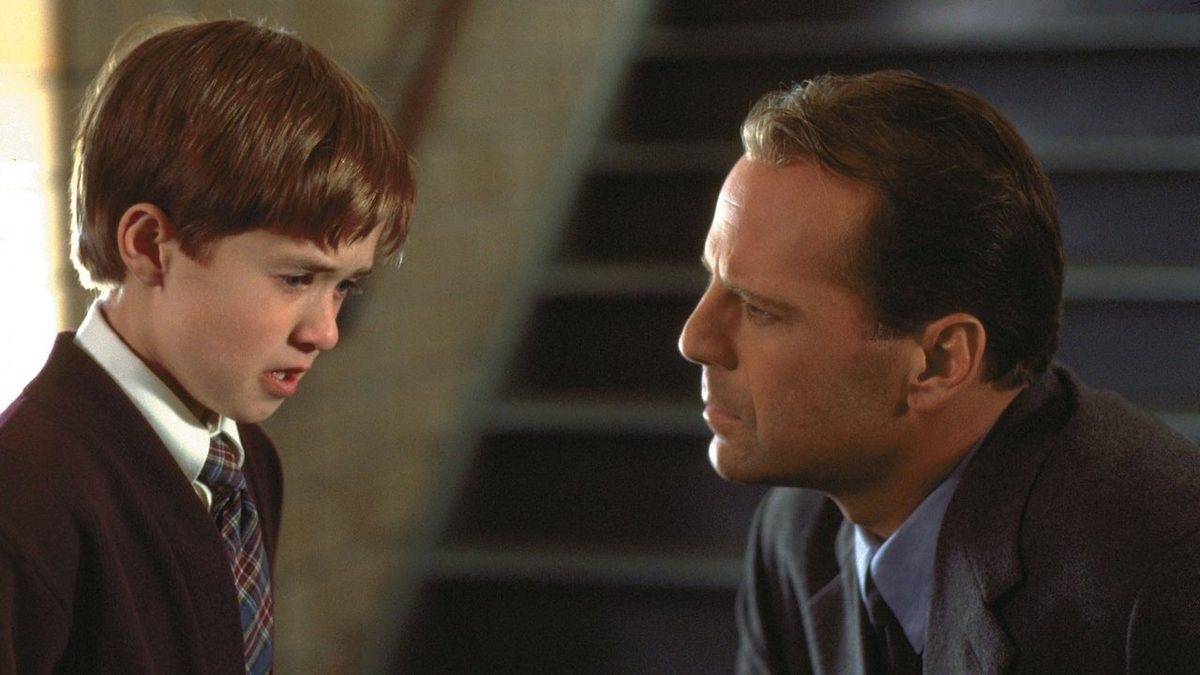
- Director: M. Night Shyamalan
- Starring: Bruce Willis, Haley Joel Osment, Toni Collette, Olivia Williams
- The Reframing: The healer is one of the ghosts who doesn’t know he’s dead
There has never been any contest. In the summer of 1999, twenty-nine-year-old filmmaker M. Night Shyamalan delivered a cinematic revelation that permanently altered Hollywood history, earned six Academy Award nominations (including Best Picture and Best Director), and became a global cultural phenomenon.
Bruce Willis delivers a quiet, beautifully restrained performance as Dr. Malcolm Crowe, a Philadelphia child psychologist struggling to rebuild his life after being shot in his home by a former patient. Seeking redemption, Malcolm takes on the case of nine-year-old Cole Sear (Haley Joel Osment), a terrified boy who confesses his supernatural burden: “I see dead people. Walking around like regular people. They don’t see each other. They only see what they want to see. They don’t know they’re dead.”
When Malcolm returns home in the final sequence, he watches his sleeping wife drop his wedding ring on the hardwood floor. Malcolm looks down at his hand: he is not wearing his ring.
In an electrifying 90-second montage, Shyamalan re-evaluates the entire film: Malcolm never survived the gunshot in the prologue. He never moved a chair, never opened a door, never spoke to Cole’s mother, and only wore the same clothes from the night of his death.
The Sixth Sense remains the gold standard because its twist does not exploit the audience; it resolves the emotional tragedy of a ghost who needed to help an isolated child before he could let go and say goodbye to the love of his life.
Why Great Plot Twists Stand the Test of Time
Bad plot twists rely on withheld information, cheating the audience with cheap surprises that crumble on second viewing.
Masterpieces like The Sixth Sense, The Prestige, and Fight Club achieve immortality because their twists are completely fair. The filmmakers give the audience all the pieces of the puzzle; our own assumptions simply blind us to how they connect. When a film tricks us through psychological storytelling rather than narrative deception, walking out of the theater feels like waking up from a brilliant dream—and immediately wanting to step back inside.