
No filmmakers in modern American cinema have blended existential dread, linguistic virtuosity, and razor-sharp satire quite like Joel and Ethan Coen. Over four decades, the Minnesota-born brothers have hopped seamlessly between genres—neo-noir, screwball farce, dusty Westerns, and musical parables—while maintaining a unified moral cosmos.
In a Coen brothers universe, human beings are rarely evil masterminds; they are bumbling, greedy, self-important fools who hatch petty schemes they cannot control. Fate is an indifferent spectator, violence is sudden and messy, and cosmic justice often arrives in the shape of an errant bowling ball or a woodchipper. Yet balanced against this icy cynicism is an abiding affection for eccentric regional dialects and decent, hardworking souls trying to make sense of the absurdity.
From slapstick kidnap capers to Academy Award-winning masterpieces, here is the definitive ranking of the best Coen brothers movies of all time.
15. Hail, Caesar! (2016)
- Starring: Josh Brolin, George Clooney, Alden Ehrenreich, Ralph Fiennes, Scarlett Johansson
- The Comic Core: 1950s Hollywood studio fixer balancing communist screenwriters, pregnant starlets, and singing cowboys
A joyous, sunny valentine to Golden Age Hollywood studio craftsmanship, Hail, Caesar! follows Eddie Mannix (Josh Brolin), a devout Catholic fixer at Capitol Pictures who spends 24 hours putting out catastrophic fires across the backlot. When superstar Baird Whitlock (George Clooney) is kidnapped by a cell of Marxist screenwriters calling themselves “The Future,” Mannix must pay the ransom while keeping the press at bay.
The film is packed with showstopping vignettes: Channing Tatum leading a tap-dancing musical number of lovelorn sailors, Ralph Fiennes attempting to teach singing cowboy Hobie Doyle (a breakout Alden Ehrenreich) how to deliver high-society dialogue (“Would that it were so simple”), and a hilarious theological summit between a rabbi, a Catholic priest, and an Orthodox minister arguing over the nature of God.
14. The Hudsucker Proxy (1994)
- Starring: Tim Robbins, Jennifer Jason Leigh, Paul Newman
- The Comic Core: Fast-talking 1930s screwball pastiche meets corporate greed
Co-written with their longtime friend Sam Raimi, The Hudsucker Proxy is the Coens’ grandest visual spectacle—a dizzying, Art Deco skyscraper fable that honors the rapid-fire comedies of Preston Sturges and Frank Capra. When the head of Hudsucker Industries jumps out a 44th-floor window, ruthless board member Sidney J. Mussburger (Paul Newman) installs clueless mailroom clerk Norville Barnes (Tim Robbins) as CEO to tank the stock so the board can buy it cheaply.
Norville, however, has a secret blueprint: a simple circle on a napkin with the note, “You know, for kids!” The invention is the Hula Hoop, and it becomes a global sensation. Jennifer Jason Leigh delivers a tour de force of machine-gun 1930s newsroom patter as reporter Amy Archer, while Roger Deakins’ camera sweeps through cavernous boardrooms and ticking clock towers with breathtaking mechanical grace.
13. Burn After Reading (2008)
- Starring: Frances McDormand, Brad Pitt, George Clooney, John Malkovich, Tilda Swinton
- The Comic Core: A spy thriller where literally every single participant is an utter moron
Arriving immediately after the grim, Oscar-winning triumph of No Country for Old Men, Burn After Reading was a deliberate act of comedic deflation. When an ousted CIA analyst (John Malkovich) leaves his unhinged memoir notes on a gym locker-room floor, two delusional personal trainers—Chad Feldheimer (Brad Pitt) and Linda Litzke (Frances McDormand)—mistake it for classified state intelligence and attempt to blackmail him to fund Linda’s cosmetic surgeries.
Brad Pitt gives one of the funniest performances of his career as Chad, a bouncy, gum-chewing fitness bro who thinks he is an international espionage operative. The film’s climactic meeting between bewildered CIA directors (led by J.K. Simmons) trying to decipher what happened—only to conclude they learned nothing and should never speak of it again—is a scathing indictment of institutional stupidity.
12. The Man Who Wasn’t There (2001)
- Starring: Billy Bob Thornton, Frances McDormand, James Gandolfini, Scarlett Johansson
- The Comic Core: A laconic small-town barber whose quiet blackmail plot detonates into tragedy
Shot in glorious high-contrast black-and-white by Roger Deakins, The Man Who Wasn’t There is a quiet, melancholic neo-noir set in 1949 California. Billy Bob Thornton plays Ed Crane, an uncommunicative barber who rarely speaks, never smiles, and chain-smokes his way through life. Suspecting his wife (Frances McDormand) is having an affair with her boss (James Gandolfini), Ed anonymously blackmails him to invest in a revolutionary new technology: dry cleaning.
The scheme, naturally, unravels into murder, UFO sightings, and courtroom absurdity. Thornton’s deadpan, interior voiceover carries the film’s existential weight, reflecting on hair as a living, growing tumor and human existence as an accidental detour. It is one of the Coens’ most visually pristine and underrated works.
11. True Grit (2010)
- Starring: Jeff Bridges, Hailee Steinfeld, Matt Damon, Josh Brolin
- The Comic Core: Biblical frontier prose, unyielding adolescent willpower, and a drunken marshal
Faithfully returning to Charles Portis’ 1968 novel rather than the 1969 John Wayne adaptation, the Coens crafted a magnificent Western that earned ten Academy Award nominations. Fourteen-year-old Mattie Ross (a phenomenal Hailee Steinfeld in her screen debut) hires one-eyed, drunken U.S. Marshal Rooster Cogburn (Jeff Bridges) to hunt down the outlaw who murdered her father in Indian Territory.
The film crackles with Portis’ ornate, formal 19th-century dialogue—which entirely avoids contractions—giving every exchange the cadence of Old Testament verse. Bridges delivers Cogburn with raspy, barrel-chested eccentricity, while Matt Damon brings subtle comic vanity to Texas Ranger LaBoeuf. It is a harsh, beautiful meditation on the steep personal price of vengeance.
10. Blood Simple (1984)
- Starring: John Getz, Frances McDormand, Dan Hedaya, M. Emmet Walsh
- The Comic Core: Sweaty Texas neo-noir where miscommunication proves completely lethal
Made for just $1.5 million raised from local investors, the Coens’ debut feature arrived fully formed with an astonishing command of cinematic suspense. Set in the humid flatlands of Texas, a jealous bar owner (Dan Hedaya) hires sleazy, yellow-suited private detective Loren Visser (M. Emmet Walsh) to photograph his unfaithful wife (Frances McDormand) and her bartender lover (John Getz), and then murder them.
Instead, the detective shoots the husband, steals the cash, and frames the wife. What follows is a labyrinth of catastrophic misunderstandings where no character ever knows the full truth. Walsh’s sweaty, wheezing villainy earned him an Independent Spirit Award, and Carter Burwell’s haunting piano score set the template for the brothers’ entire filmography.
9. Inside Llewyn Davis (2013)
- Starring: Oscar Isaac, Carey Mulligan, John Goodman, Justin Timberlake
- The Comic Core: The prickly, tragicomic plight of an uncompromising Greenwich Village folk artist
Set in the bitter winter of 1961 just before Bob Dylan changed the musical landscape forever, Inside Llewyn Davis follows a week in the life of a gifted, self-sabotaging folk musician (Oscar Isaac) sleeping on friends’ couches and carrying an orange tabby cat named Ulysses across Manhattan.
Isaac plays Llewyn not as an easy-to-love martyr, but as a fiercely proud, combative artist whose refusal to compromise borders on self-destruction. The musical performances (produced with T Bone Burnett and Marcus Mumford) are devastatingly authentic, and a mid-film road trip to Chicago featuring a morphine-addicted jazz poet (John Goodman) is classic Coen surrealism. It is a poignant, humorous tribute to all the brilliant artists who never made it.
8. A Serious Man (2009)
- Starring: Michael Stuhlbarg, Richard Kind, Fred Melamed
- The Comic Core: The Book of Job reset in 1967 suburban Minnesota, governed by quantum uncertainty
Deeply autobiographical and steeped in Jewish theological folklore, A Serious Man is the Coens’ most philosophical comedy. Michael Stuhlbarg stars as Larry Gopnik, a mild-mannered physics professor whose life disintegrates overnight: his wife leaves him for a pontificating widower (Fred Melamed), his tenure is threatened by anonymous libel letters, his brother (Richard Kind) sleeps on the couch draining his cyst, and his son cares only about smoking weed and Jefferson Airplane.
Desperate for answers, Larry visits a succession of rabbis, each more hilariously unhelpful than the last (from the young rabbi obsessed with parking lots to Rabbi Marshak who only listens to the radio). Grounded in Heisenberg’s Uncertainty Principle—“Even if you can’t figure it out, you’re still responsible for it”—the film finds sublime, tragicomic poetry in the silence of the universe.
7. Raising Arizona (1987)
- Starring: Nicolas Cage, Holly Hunter, John Goodman, Frances McDormand, William Forsythe
- The Comic Core: Live-action cartoon slapstick, outlaw romance, and unrepentant baby theft
After the dark grit of Blood Simple, the Coens exploded into kaleidoscopic kinetic comedy. Raising Arizona stars Nicolas Cage as H.I. McDunnough, an ex-con convenience store robber, and Holly Hunter as Ed, an infertile former police officer. Desperate to start a family, they decide to steal one of the quintuplets born to unpainted-furniture magnate Nathan Arizona: “They had more than they could handle.”
Featuring breakneck tracking shots, manic pacing, and wild physical comedy, the film plays like a live-action Warner Bros. cartoon. Cage with his rooster haircut sprinting through suburban backyards with a pack of howling dogs while stealing pantyhose and Huggies diapers is one of the most exhilarating comedic chases ever captured on celluloid.
6. Barton Fink (1991)
- Starring: John Turturro, John Goodman, Judy Davis, Michael Lerner
- The Comic Core: Writer’s block inside a melting Hollywood hotel room that doubles as the underworld
Written in a feverish three-week burst while the Coens were struggling with the script for Miller’s Crossing, Barton Fink swept the 1991 Cannes Film Festival, winning the Palme d’Or, Best Director, and Best Actor. John Turturro stars as Barton, a pretentious 1941 New York playwright lured to Hollywood to write a Wallace Beery wrestling picture for Capitol Pictures.
Checked into the eerie Hotel Earle—where the wallpaper sweats paste and shoes sit abandoned in the hallway—Barton’s self-righteous artistic posturing collides with his affable, insurance-salesman neighbor Charlie Meadows (John Goodman). When the hotel literally bursts into flames and Charlie reveals his true terrifying nature (“I’LL SHOW YOU THE LIFE OF THE MIND!”), the film transforms into a horrifying, darkly hilarious indictment of intellectual hypocrisy.
5. Miller’s Crossing (1990)
- Starring: Gabriel Byrne, Albert Finney, John Turturro, Marcia Gay Harden, Jon Polito
- The Comic Core: Shakespearean mob politics, intricate betrayal, and stoic loyalty in the woods
Set during Prohibition in an unnamed corrupt American city, Miller’s Crossing is the Coens’ gangster masterpiece. Tom Reagan (Gabriel Byrne) is the sharp-witted advisor to Irish political boss Leo O’Bannon (Albert Finney). When a rival Italian mobster (Jon Polito) demands the execution of a sleazy bookie (John Turturro), Tom finds himself trapped between loyalty, love, and survival.
Barry Sonnenfeld’s lush cinematography and the Coens’ dense, stylized 1930s underworld slang (“What’s the rumpus?”, “giving someone the high-hat”) elevate the film to literary greatness. Turturro begging for his life in the autumnal forest of Miller’s Crossing (“Look in your heart!”) and Finney mowing down hitmen with a Tommy gun to the strains of “Danny Boy” are two of cinema’s most indelible sequences.
4. O Brother, Where Art Thou? (2000)
- Starring: George Clooney, John Turturro, Tim Blake Nelson, John Goodman, Holly Hunter
- The Comic Core: Homer’s Odyssey reborn as a Depression-era Mississippi chain-gang musical
Ranked among our breakdown of the 15 best films in prison of all time, O Brother, Where Art Thou? is a magnificent triumph of American folk mythology. George Clooney stars as Ulysses Everett McGill, an articulate, vain convict obsessed with Dapper Dan pomade who escapes a chain gang with his gullible cohorts to retrieve a hidden fortune before a valley is flooded by the Tennessee Valley Authority.
Pioneering digital color grading to give rural Mississippi a sepia-dusted, fairy-tale glow, the Coens populate their journey with sirens, one-eyed Bible salesmen, blind seers, and bank robber Baby Face Nelson. When the trio inadvertently records “Man of Constant Sorrow” as the Soggy Bottom Boys, they spark a cultural phenomenon that won Album of the Year at the Grammys and cemented the film as an eternal comedy classic.
3. No Country for Old Men (2007)
- Starring: Tommy Lee Jones, Javier Bardem, Josh Brolin, Woody Harrelson, Kelly Macdonald
- The Comic Core: The bleak absurdity of fate, chance, and an unstoppable cosmic executioner
Adapted from Cormac McCarthy’s brutal novel, No Country for Old Men won four Academy Awards, including Best Picture and Best Director. When welder Llewelyn Moss (Josh Brolin) discovers a satchel containing $2 million amidst the bloody carnage of a botched drug deal in the West Texas desert, he sets off a relentless pursuit by Anton Chigurh (Javier Bardem in an Oscar-winning turn), a psychopathic hitman wielding a cattle stun-gun who decides human lives on a coin toss.
While primarily a tense, breathless thriller with almost zero musical score, the film possesses the Coens’ trademark pitch-black irony. The gas station coin-toss scene is a masterclass in psychological terror, and Tommy Lee Jones’ weary, melancholy Sheriff Bell serves as the mournful moral compass of a world that has outpaced human decency.
2. The Big Lebowski (1998)
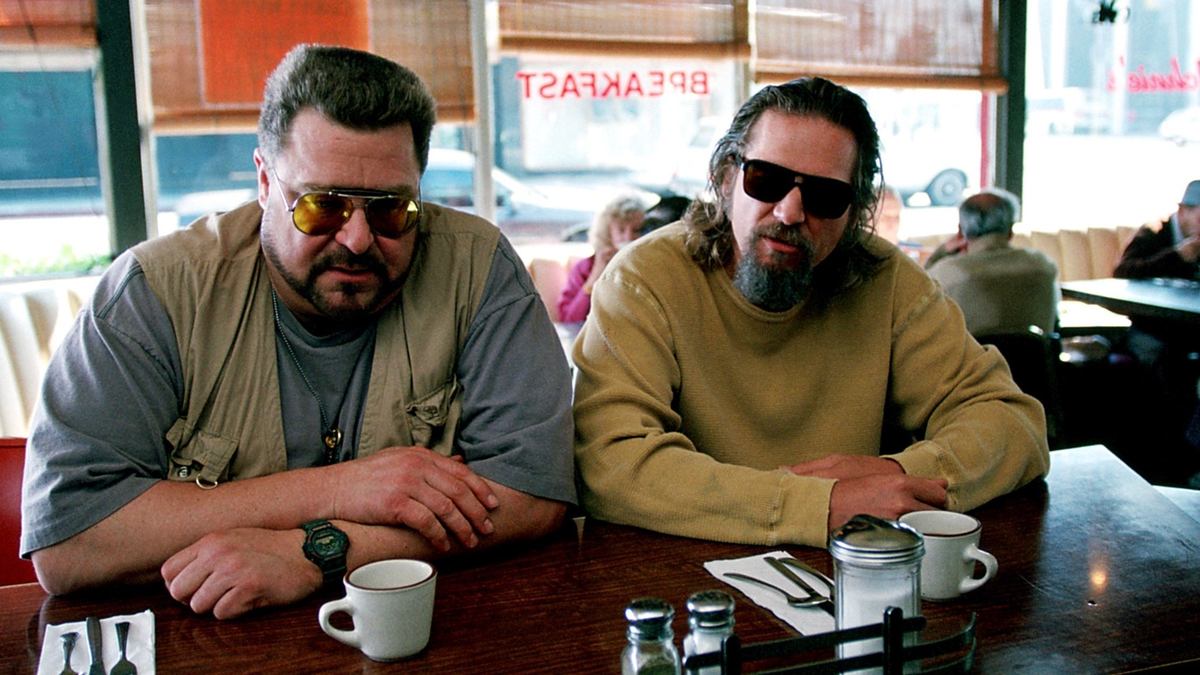
- Starring: Jeff Bridges, John Goodman, Julianne Moore, Steve Buscemi, Philip Seymour Hoffman
- The Comic Core: Raymond Chandler detective noir filtered through a bowling alley and a White Russian
Few films in history have generated an entire cultural religion (Dudeism), annual festivals, and universal quote-ability quite like The Big Lebowski. Jeff Bridges stars as Jeffrey “The Dude” Lebowski—an unemployed slacker residing in Venice, California who enjoys bowling, Creedence Clearwater Revival, and White Russians. When two thugs mistake him for a millionaire philanthropist with the same name and urinate on his favorite rug (“it really tied the room together”), The Dude embarks on a convoluted ransom odyssey.
Every single performance is comedic gold: John Goodman’s unhinged, Vietnam-obsessed Walter Sobchak, Julianne Moore’s avant-garde feminist artist Maude, Philip Seymour Hoffman’s sycophantic assistant Brandt, and John Turturro’s purple-clad bowling rival Jesus Quintana. Much like the dry, stylized worlds crafted in every Wes Anderson film, The Big Lebowski is an aesthetic universe unto itself—a film that gets richer, funnier, and more comforting with every single viewing.
1. Fargo (1996)
- Starring: Frances McDormand, William H. Macy, Steve Buscemi, Peter Stormare, Harve Presnell
- The Comic Core: “Minnesota Nice” decency standing firm against desperate, bumbling small-time greed
There was never any doubt. Fargo is Joel and Ethan Coen’s crowning achievement—a flawless synthesis of dark comedy, shocking brutality, and radiant human decency. Set against the blinding, white, frozen expanse of wintertime North Dakota and Minnesota, desperate car salesman Jerry Lundegaard (William H. Macy in a tragicomic masterpiece of nervous stammering) hires two sleazy criminals (Steve Buscemi and Peter Stormare) to kidnap his own wife to extort a ransom from his wealthy father-in-law.
When the botched kidnapping leaves three people dead on a rural highway, pregnant Brainerd Police Chief Marge Gunderson (Frances McDormand in an Oscar-winning performance) takes the case.
Marge is the ultimate anti-cynical hero. While Jerry and the kidnappers tear themselves apart over money, Marge investigates the crime with cheerfulness, stopping for hot Arby’s lunches and greeting everyone with a friendly “Oh, ya betcha!” Her final monologue to the captured killer in the back of her squad car—pondering why anyone would commit murder on such a beautiful day for a little bit of money—is the emotional and moral heartbeat of the Coens’ entire body of work.
Why the Coens’ Vision Endures
The enduring magic of Joel and Ethan Coen lies in their refusal to treat audiences like children. They understand that the world is chaotic, irrational, and frequently unfair. Yet by examining human frailty through the prism of dark wit, regional music, and immaculate craft, they transform existential confusion into cinematic joy. Long may they abide.