
No single author has exerted a more profound, enduring gravity over modern American cinema than Stephen King. Since Brian De Palma first drenched Sissy Spacek in pig’s blood in 1976, more than eighty feature films, miniseries, and television adaptations have attempted to capture the “Master of Horror’s” singular alchemy.
Yet the term “horror author” has always been an overly reductive label for King’s genius. While his stories traffic in haunted hotels, telekinetic fury, and sewer-dwelling cosmic entities, the true engine of King’s work is his deep, unsparing empathy for flawed human beings. His finest narratives are grounded not in monsters, but in the agony of childhood grief, the prison of addiction, the corruption of institutional power, and the salvation of lifelong friendship.
Over five decades, visionary filmmakers—from Stanley Kubrick and Brian De Palma to Rob Reiner, David Cronenberg, and Frank Darabont—have wrestled with King’s expansive prose. Some adaptations adhered fanatically to the printed page; others radically reimagined the source material to create standalone cinematic milestones.
Whether you are seeking bone-chilling supernatural terror or timeless human drama, here is the definitive critical ranking of the 15 best Stephen King movies of all time.
15. Christine (1983)
- Director: John Carpenter
- Starring: Keith Gordon, John Stockwell, Alexandra Paul, Robert Prosky
- The Stephen King Touch: American automotive obsession transformed into lethal supernatural possession
Pairing the master of prose horror with the master of synth-driven cinematic dread was a match made in genre heaven. Coming off the critical shellacking of The Thing, John Carpenter approached King’s 1983 novel about a cherry-red 1958 Plymouth Fury with sleek, no-nonsense craftsmanship.
Keith Gordon gives a wonderfully creepy, transformative performance as Arnie Cunningham, a bullied high school outcast whose personality curdles into 1950s greaser arrogance as he restores the murderous vehicle. Donald M. Morgan’s cinematography makes the car feel genuinely alive, headlights glowing like demonic eyes through suburban smoke. Backed by Carpenter’s iconic pulsing electronic score and George Thorogood riffs, Christine remains an effortlessly cool slice of 1980s vehicular terror.
14. 1408 (2007)
- Director: Mikael Håfström
- Starring: John Cusack, Samuel L. Jackson, Mary McCormack, Tony Shalhoub
- The Stephen King Touch: Skepticism dismantled by pure architectural malevolence
Adapted from a 1999 short story that King originally wrote as an exercise for his craft memoir On Writing, 1408 is one of the most underrated psychological chillers of the 2000s. John Cusack plays Mike Enslin, an estranged father and cynical non-fiction author who debunks haunted tourist traps after the devastating death of his young daughter.
Ignoring the chilling warnings of hotel manager Gerald Olin (a delightfully ominous Samuel L. Jackson), Enslin checks into Room 1408 at Manhattan’s Dolphin Hotel. What follows is a tour-de-force solo performance from Cusack. The room does not merely display ghosts; it weaponizes Enslin’s grief, regret, and sanity, warping time and physics inside a hermetically sealed nightmare. The counting-down alarm clock sequence and the phantom Skype calls remain peak King psychological torment.
13. The Mist (2007)
- Director: Frank Darabont
- Starring: Thomas Jane, Marcia Gay Harden, Laurie Holden, Andre Braugher, Toby Jones
- The Stephen King Touch: Monsters outside the supermarket, but real evil within
Before Frank Darabont launched The Walking Dead, he proved his apocalyptic bona fides with this relentlessly bleak adaptation of King’s 1980 novella. When a military experiment tears a rift in spacetime, a supernatural fog rolls over a small Maine town, trapping dozens of townsfolk inside a local grocery store while Lovecraftian horrors lurk outside.
While the otherworldly creature designs are frightening, The Mist derives its deepest terror from social collapse. Marcia Gay Harden delivers a skin-crawling, tour-de-force performance as Mrs. Carmody, a religious fanatic who whips the terrified shoppers into blood-sacrificing hysteria. And then there is the climax: Darabont replaced King’s ambiguous open-ended prose conclusion with the most emotionally devastating, gut-punch twist in 21st-century cinema—an ending Stephen King publicly praised as superior to his own.
12. Salem’s Lot (1979)
- Director: Tobe Hooper
- Starring: David Soul, James Mason, Lance Kerwin, Reggie Nalder
- The Stephen King Touch: Small-town New England decay overtaken by European Gothic vampirism
Technically produced as a two-part CBS miniseries before receiving international theatrical release, Tobe Hooper’s Salem’s Lot terrified an entire generation of viewers. King set out to answer a simple premise: what if Count Dracula arrived in a sleepy contemporary Maine village? Hooper answered with indelible, nightmare-inducing imagery.
Reggie Nalder’s Kurt Barlow—modeled directly after Max Schreck’s rat-like Count Orlok from F.W. Murnau’s Nosferatu rather than a suave Bela Lugosi—remains one of the scariest monsters ever broadcast on television. Who could ever forget little Ralphie Glick hovering in the night fog outside Mark Petrie’s second-story bedroom window, scratching his fingernails against the glass? James Mason adds regal gravitas as human familiar Richard Straker, grounding the gothic horror in tangible human menace.
11. The Dead Zone (1983)
- Director: David Cronenberg
- Starring: Christopher Walken, Martin Sheen, Brooke Adams, Tom Skerritt, Herbert Lom
- The Stephen King Touch: The agonizing moral burden of clairvoyance
Directing King’s 1979 tragic thriller, Canadian body-horror auteur David Cronenberg dialed back his trademark visceral gore to craft an intensely melancholic, deeply human character study. Christopher Walken delivers one of the finest, most delicate performances of his legendary career as Johnny Smith, a gentle Maine schoolteacher who wakes from a five-year coma with the psychic ability to foresee traumatic events through physical touch.
Walken infuses Johnny with a heartbreaking vulnerability; every vision drains his physical body, transforming his clairvoyant “gift” into an isolating curse. When Johnny shakes the hand of corrupt populist politician Greg Stillson (a terrifyingly prophetic Martin Sheen) and glimpses a future nuclear holocaust, the film accelerates into a moral crucible: is it justifiable to assassinate a tyrant before he ascends to power? It stands as one of the smartest political thrillers of the decade.
10. Doctor Sleep (2019)
- Director: Mike Flanagan
- Starring: Ewan McGregor, Rebecca Ferguson, Kyliegh Curran, Cliff Curtis
- The Stephen King Touch: Generational trauma, 12-step recovery, and psychic warfare
Adapting King’s 2013 sequel novel was an impossible task. Director Mike Flanagan had to simultaneously adapt King’s book while honoring Stanley Kubrick’s 1980 masterpiece—a film King famously despised for deviating from his text. As explored across our comprehensive breakdown of every Mike Flanagan movie and TV show ranked, Flanagan pulled off a cinematic miracle.
Ewan McGregor is brilliant as middle-aged Dan Torrance, an alcoholic drifter fighting to quiet the screaming ghosts of the Overlook Hotel through AA meetings and quiet hospice work. But the film is stolen by Rebecca Ferguson as Rose the Hat, leader of the True Knot—a nomadic cult of quasi-immortal psychic vampires who feed on the “steam” of gifted children. The Director’s Cut (clocking in at three hours) seamlessly bridges the warmth of King’s literary philosophy with the clinical geometry of Kubrick’s visual universe.
9. It: Chapter One (2017)
- Director: Andy Muschietti
- Starring: Bill Skarsgård, Jaeden Martell, Sophia Lillis, Finn Wolfhard, Wyatt Oleff
- The Stephen King Touch: Childhood friendship as the ultimate shield against existential evil
Translating King’s 1,138-page magnum opus into feature films had defeated Hollywood for decades. Andy Muschietti cracked the code by splitting the sprawling multi-generational timeline in two, focusing Chapter One entirely on the 1989 childhood timeline of the Losers’ Club in Derry, Maine.
Bill Skarsgård stepped into the oversized clown shoes of Tim Curry’s iconic 1990 miniseries turn and created something entirely alien: Pennywise the Dancing Clown as a feral, drooling, shape-shifting cosmic predator. Yet the secret weapon of the film is the palpable chemistry between its young ensemble. Sophia Lillis, Finn Wolfhard, and Jaeden Martell capture the profane, tender vulnerability of growing up in a town rotten with adult cruelty. With over \$700 million at the global box office, it remains the highest-grossing horror movie in history.
8. Gerald’s Game (2017)
- Director: Mike Flanagan
- Starring: Carla Gugino, Bruce Greenwood, Carel Struycken, Henry Thomas
- The Stephen King Touch: Psychological dissociation and breaking the handcuffs of lifelong abuse
For twenty-five years, Hollywood considered King’s 1992 novel completely unfilmable: a woman handcuffed to a bedposts in an isolated Maine cabin after her husband dies of a sudden heart attack, with nearly the entire narrative unfolding inside her internal monologue.
Flanagan cracked the narrative code by exteriorizing Jessie Burlingame’s (Carla Gugino) inner psyche into hallucinated versions of herself and her deceased husband (Bruce Greenwood). Gugino delivers a tour de force, carrying the emotional weight of childhood sexual trauma alongside agonizing physical survival. Featuring one of the most viscerally shocking gore sequences in modern cinema—the infamous “degloving” scene—and the petrifying silhouette of the Moonlight Man (Carel Struycken), Gerald’s Game is a triumph of psychological survival horror.
7. Pet Sematary (1989)
- Director: Mary Lambert
- Starring: Dale Midkiff, Fred Gwynne, Denise Crosby, Miko Hughes
- The Stephen King Touch: The unbearable madness of parental grief: “Sometimes, dead is better.”
Stephen King famously found his own 1983 novel so disturbing that he shoved it into a desk drawer and refused to submit it to his publisher until contractual obligations forced his hand. When Mary Lambert directed the 1989 feature film—from a screenplay penned by King himself—she retained every drop of the book’s grim, nihilistic power.
Fred Gwynne turns in a career-defining performance as neighbor Jud Crandall, introducing young physician Louis Creed (Dale Midkiff) to the sour Indian burial ground that brings dead pets—and eventually, deceased children—back as monstrous perversions of life. From the terrifying spinal meningitis hallucinations of Zelda to toddler Gage Creed (Miko Hughes) wielding a scalpel in a blue sailor suit, Pet Sematary taps directly into the primal nightmare of every parent.
6. Carrie (1976)
- Director: Brian De Palma
- Starring: Sissy Spacek, Piper Laurie, Amy Irving, William Katt, John Travolta
- The Stephen King Touch: High school cruelty ignited by telekinetic vengeance
The film that launched the Stephen King cinematic universe remains one of its absolute greatest achievements. Brian De Palma took King’s debut epistolary novel and filtered it through his distinctive Hitchcockian visual grammar, deploying split-screen frames, dreamy slow motion, and operatic baroque violence.
Sissy Spacek earned an Academy Award nomination for her heartbreaking performance as Carrie White, an introverted, abused teenager terrorized by her cruel high school peers and smothered by her fanatically religious mother, Margaret (an equally nominated Piper Laurie). The prom night bucket of pig’s blood, followed by Carrie’s wide-eyed, silent telekinetic slaughter of the gymnasium, is an indelible cornerstone of modern cinema. And the final jump-scare hand reaching through the dirt established a genre trope that horror directors have copied for half a century.
5. The Green Mile (1999)
- Director: Frank Darabont
- Starring: Tom Hanks, Michael Clarke Duncan, David Morse, Bonnie Hunt, Sam Rockwell
- The Stephen King Touch: Divine miracles intersecting with the brutal banality of death row
Reuniting with Frank Darabont five years after The Shawshank Redemption, this epic three-hour adaptation of King’s serialized 1996 novel demonstrated once again that King and Darabont shared a profound spiritual kinship. Set in 1935 Louisiana on Cold Mountain Penitentiary’s death row (“The Green Mile”), the film balances somber procedural reality with gentle magical realism.
Tom Hanks provides steady, empathetic moral gravity as death row supervisor Paul Edgecomb—a stark contrast to his fiery managerial comedy across the best baseball movies—while the late Michael Clarke Duncan earned an Oscar nomination for his towering, tearful performance as John Coffey—a giant, childlike inmate falsely convicted of murder who possesses miraculous healing powers. With unforgettable supporting work from Sam Rockwell as unhinged psychopath “Wild Bill” Wharton and Doug Hutchison as sadistic guard Percy Wetmore, The Green Mile is a devastating meditation on the cruelty of the world and the heavy burden of living too long.
4. Misery (1990)
- Director: Rob Reiner
- Starring: Kathy Bates, James Caan, Richard Farnsworth, Frances Sternhagen
- The Stephen King Touch: The claustrophobic prison of toxic fandom and creative captivity
Stephen King wrote Misery as an allegory for his own battles with cocaine addiction and fans who felt entitled to dictate his creative choices. Under Rob Reiner’s razor-sharp direction and William Goldman’s crackling screenplay, the film became the gold standard of modern claustrophobic thrillers.
Kathy Bates achieved cinematic immortality as Annie Wilkes, the unhinged former nurse who rescues romance novelist Paul Sheldon (James Caan) from a snowy car crash only to hold him hostage when she discovers he killed off her favorite character. Bates’ chilling swings between sweet Midwestern folksiness (“dirty birdie!”) and cold-blooded psychopathy won her the Academy Award for Best Actress—making Misery the only film adaptation of a Stephen King novel to ever win an Oscar for acting. The wince-inducing hobbling scene with a sledgehammer and two-by-four remains etched into cinematic history.
3. Stand by Me (1986)
- Director: Rob Reiner
- Starring: Wil Wheaton, River Phoenix, Corey Feldman, Jerry O’Connell, Kiefer Sutherland
- The Stephen King Touch: The tender, heartbreaking final summer of boyhood innocence
Adapted from King’s non-horror novella The Body (from the 1982 collection Different Seasons), Stand by Me is widely considered by critics—and by King himself—to be one of the truest, most emotionally resonant adaptations ever committed to celluloid. Upon viewing a private screening, King reportedly walked away in tears, stating it was the first time an adaptation truly captured his soul.
Set over Labor Day weekend in 1959, four twelve-year-old boys in Castle Rock, Oregon, set out on a two-day trek along railroad tracks to find the body of a missing boy. Rob Reiner avoids saccharine sentimentality, capturing the authentic bravado, vulgar humor, and deep anxieties of adolescent boys on the cusp of adulthood. River Phoenix’s luminous performance as Chris Chambers, breaking down beside the campfire under the weight of his family’s bad reputation, showcases one of the greatest young acting talents cut tragically short. As Richard Dreyfuss’s adult Gordie Lachance writes in the film’s immortal final line: “I never had any friends later on like the ones I had when I was twelve. Jesus, does anyone?”
2. The Shining (1980)
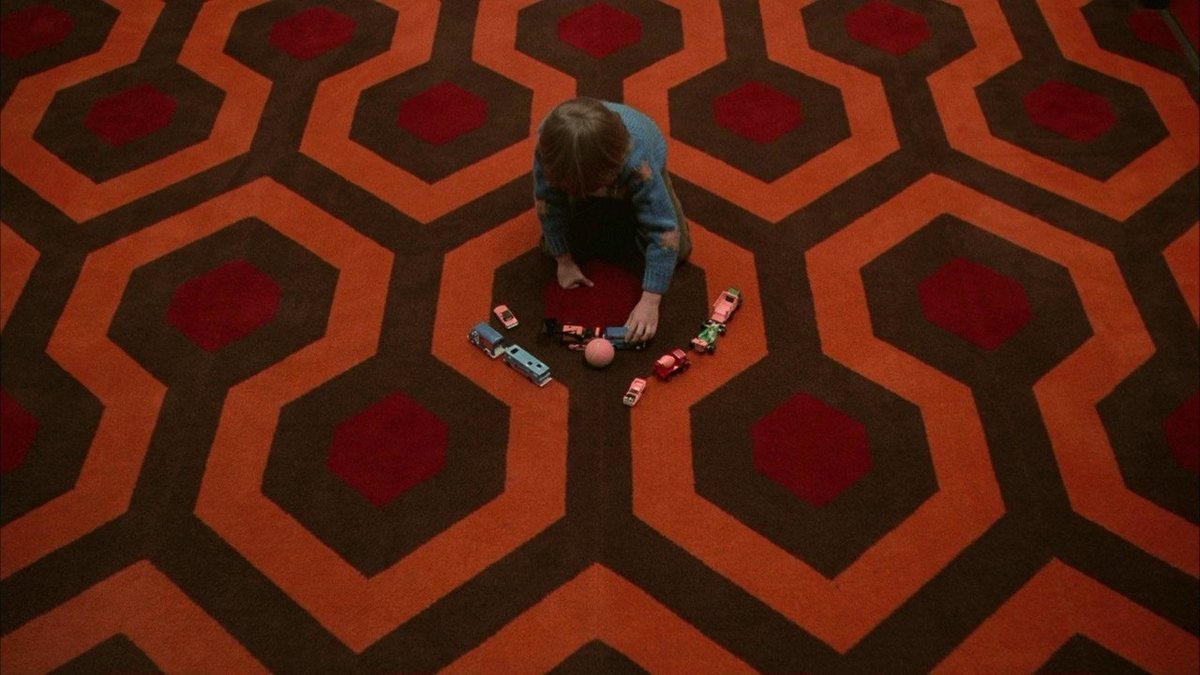
- Director: Stanley Kubrick
- Starring: Jack Nicholson, Shelley Duvall, Danny Lloyd, Scatman Crothers
- The Stephen King Touch: Architectural madness, domestic isolation, and inherited family violence
It is Hollywood’s most legendary creative feud: Stephen King wrote a deeply personal tragedy about an alcoholic father struggling to protect his family from the supernatural possession of an isolated Colorado hotel; Stanley Kubrick discarded King’s warmth, turning The Shining into an icy, labyrinthine dissection of human madness and domestic slaughter. King may have hated Kubrick’s deviations, but cinema history rendered its own verdict: The Shining is an undisputed, towering masterpiece of psychological horror.
Kubrick’s revolutionary use of the Steadicam glides through the endless geometric hallways of the Overlook Hotel, tracking young Danny’s big-wheel tricycle toward Room 237 and the spectral Grady twins. Shelley Duvall’s frantic, genuine terror anchors the film’s emotional stakes, while Jack Nicholson delivers an operatic, unhinged descent into murderous lunacy. From the blood pouring out of elevator doors to the axe splitting the bathroom door (“Here’s Johnny!”), The Shining has generated more analytical obsession, documentary investigations (Room 237), and cultural homages than almost any horror film ever made.
1. The Shawshank Redemption (1994)
- Director: Frank Darabont
- Starring: Tim Robbins, Morgan Freeman, Bob Gunton, William Sadler, Clancy Brown, James Whitmore
- The Stephen King Touch: Patience, human dignity, and the invincible triumph of hope
There was never any contest. Adapted from King’s 1982 novella Rita Hayworth and Shawshank Redemption, Frank Darabont’s 1994 masterpiece was famously a box office disappointment upon release, overshadowed by Pulp Fiction and Forrest Gump. But through television syndication and home video word-of-mouth, it rose to become the #1 rated film of all time on IMDb and a permanent fixture in global cultural consciousness.
Wrongly convicted banker Andy Dufresne (Tim Robbins) and institutionalized contraband smuggler Ellis Boyd “Red” Redding (Morgan Freeman, delivering the greatest voiceover narration in Hollywood history) form a decades-long friendship inside the grim stone walls of Maine’s Shawshank State Penitentiary. Darabont treats every inmate and guard with rich, novelistic detail, creating a cinematic world where small victories—cold beers on a tar roof, Mozart playing over the courtyard PA—feel like miracles.
Much like the timeless survival spirit celebrated in our look at the 15 best films in prison ranked, The Shawshank Redemption endures because it speaks to the fundamental resilience of the human soul. Andy crawling through five hundred yards of sewer pipe to stand cleansed in the pouring rain is the definitive cinematic image of freedom. “Hope is a good thing, maybe the best of things, and no good thing ever dies.”
The Enduring Legacy of Stephen King on Screen
What allows Stephen King’s stories to survive decades of changing cinematic trends is their emotional authenticity. Flashy visual effects and monster prosthetics age, but the bond between four boys walking down a railroad track in Stand by Me, the claustrophobic dread of an isolated cabin in Misery, and the quiet handshake on a sun-drenched beach in Zihuatanejo will remain immortal as long as people gather in dark theaters to believe in stories.