
Before the golden age of prestige television took flight, Buffy the Vampire Slayer (1997–2003) rewrote the DNA of serialized storytelling. Conceived as a radical subversion of classic horror tropes—where the helpless blonde cheerleader lured into a dark alley doesn’t scream and die, but turns around and kicks the vampire’s head through a brick wall—the series evolved into a profound metaphor for the agonizing trials of growing up.
On the surface, Sunnydale, California was a sleepy suburban town built atop a mystical Hellmouth. Beneath that pulp premise lay some of the most sophisticated character arcs, razor-sharp dialogue, and tragic psychological drama ever broadcast. The show’s brilliance lived inside the “Scooby Gang”—a found family of outcasts whose banter, moral failures, and sacrifices carried seven seasons of supernatural warfare.
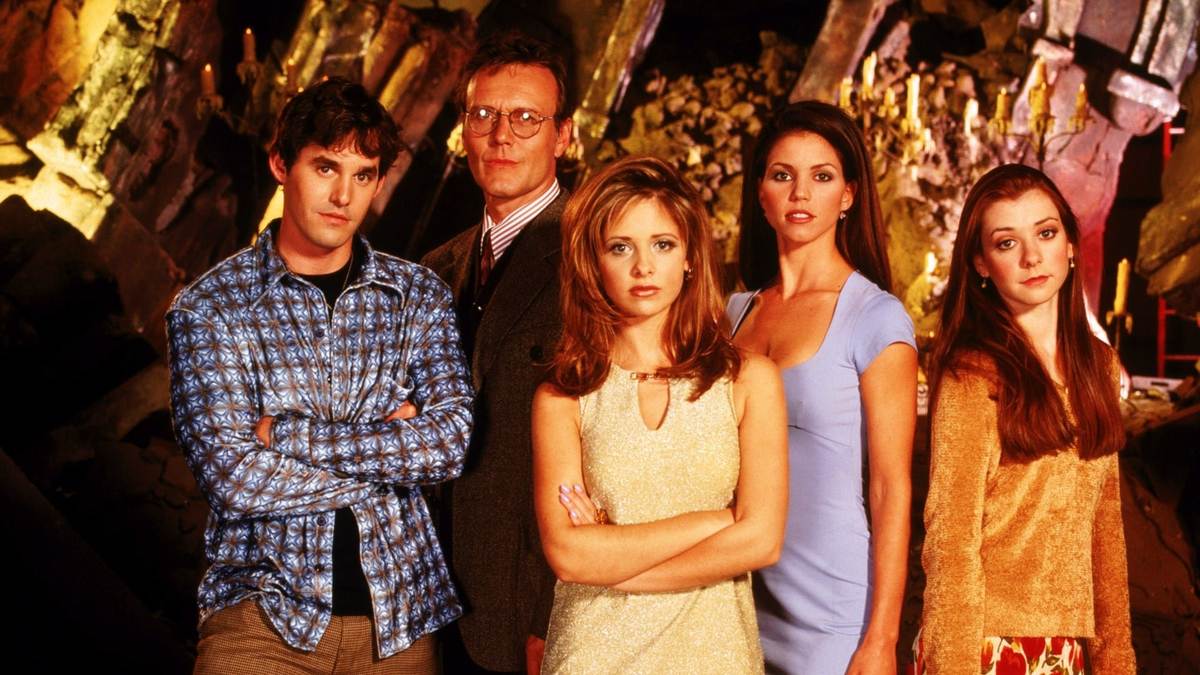
From centuries-old punk vampires to vengeance demons terrified of bunnies, here is the definitive critical ranking of the 15 greatest Buffy the Vampire Slayer characters.
15. Dawn Summers (Michelle Trachtenberg)
- First Appearance: Season 5, Episode 1 (“Buffy vs. Dracula”)
- The Archetype: Living mystical cosmic energy forced into teenage angst
- Defining Moment: Choosing to jump into the portal to save the world in “The Gift”
Few character introductions in television history were as daring as Dawn Summers. Dropped unceremoniously into Season 5 as Buffy’s supposed 14-year-old sister with retroactively altered family memories, Dawn was revealed to be “The Key”—ancient, primordial energy transformed into human flesh by monks seeking the Slayer’s protection.
While Dawn initially frustrated viewers with high-pitched teenage screaming and kleptomania, Michelle Trachtenberg played the existential horror of her identity with heartbreaking vulnerability. To discover your entire childhood, your diary entries, and your mother’s love are cosmic fabrications is staggering psychological trauma. Dawn’s evolution into a capable junior researcher and Watcher in Season 7 gave her arc genuine maturity.
14. Glory / Glorificus (Clare Kramer)
- First Appearance: Season 5, Episode 5 (“No Place Like Home”)
- The Archetype: Megalomaniacal Hell-god wrapped in a high-fashion runway model
- Defining Moment: Effortlessly punching through brick walls while complaining about shoe stains
Glory is the most formidable physical adversary Buffy ever faced. A banished Hell-god sharing a mortal body with mild-mannered medical intern Ben, Glory was virtually indestructible, possessing superhuman speed and the ability to drain human sanity through her fingertips to sustain her form.
Clare Kramer played Glory with electric, narcissistic delight. She treated universe-destroying destruction with the casual exasperation of a socialite having a bad hair day. Balancing bubbly valley-girl vanity with terrifying, unhinged divine fury, Glory pushed Buffy to the absolute limit, forcing the Slayer to make the ultimate self-sacrifice to protect the multiverse.
13. Mayor Richard Wilkins (Harry Groener)
- First Appearance: Season 3, Episode 11 (“Gingerbread”)
- The Archetype: 1950s family-values politician concealing a demonic century-old warlock
- Defining Moment: Bandaging Faith’s wounds and offering her fresh milk and comic books
Television villains rarely possess as much wholesome charm as Richard Wilkins III. The immortal founder and mayor of Sunnydale, Wilkins spent a century preparing for his “Ascension” into a pure demon during the high school graduation ceremony.
Harry Groener played the Mayor as a cheerful, germ-obsessed Boy Scout leader who constantly reminded his vampire minions to floss, wipe their feet, and avoid profanity. What made Wilkins unforgettable was his genuine, paternal affection for Faith. In a town full of manipulative monsters, the villainous Mayor was the only person who truly made Faith feel seen and loved, making their tragic dynamic deeply compelling.
12. Daniel “Oz” Osbourne (Seth Green)
- First Appearance: Season 2, Episode 4 (“Inca Mummy Girl”)
- The Archetype: Deadpan rock guitarist, stoic boyfriend, and monthly lycanthrope
- Defining Moment: Silently staring at Willow in an Eskimo coat and declaring, “Who is that girl?”
As we explored in our comprehensive retrospective of Seth Green movies and TV shows, Green brought unmatched deadpan comedic timing to Sunnydale. Playing Oz, the low-key lead guitarist for rock band Dingoes Ate My Baby, Green provided the quiet, zen eye in the middle of Sunnydale’s supernatural storm.
When Oz was bitten by his cousin and turned into a werewolf, he approached his condition not with melodramatic despair, but with pragmatic scheduling: installing reinforced cages and triple locks in his bedroom. His gentle, patient romance with Willow gave the show its sweetest emotional anchor, and his monosyllabic reactions to insane supernatural revelations were pure comedic gold.
11. Drusilla (Juliet Landau)
- First Appearance: Season 2, Episode 3 (“School Hard”)
- The Archetype: Gothic Victorian madwoman possessing psychic clairvoyance
- Defining Moment: Hypnotizing and slaying Kendra while murmuring dark nursery rhymes
Juliet Landau crafted one of the most mesmerizing, poetic antagonists in modern horror history with Drusilla. Driven insane by Angelus in Victorian London before being sired, Drusilla walked the earth as an eternal child-madwoman, talking to porcelain dolls, consulting tarot cards, and staring into unseen futures.
Landau brought extraordinary physicality to the role—a flowing, fragile mantis whose soft, breathy whisper could switch in a microsecond to feral, blood-soaked violence. Her romance with Spike was the show’s dark mirror to Buffy and Angel, marked by passionate, twisted devotion that made the pair the definitive rock-and-roll vampire couple of the 1990s.
10. Tara Maclay (Amber Benson)
- First Appearance: Season 4, Episode 10 (“Hush”)
- The Archetype: The gentle Wiccan healer and the moral conscience of the group
- Defining Moment: Standing between a furious Glory and Dawn’s secret identity
Introduced in the acclaimed, dialogue-free masterpiece “Hush,” Tara Maclay was the warm, soft-spoken center of gravity the Scooby Gang desperately needed during their tumultuous college years. Her groundbreaking romantic relationship with Willow broke cultural barriers on television, portrayed with gentle intimacy, mutual respect, and profound empathy.
Amber Benson imbued Tara with an inner steel that grew each season. Overcoming her family’s manipulative gaslighting in Season 5’s “Family,” Tara became the only member of the Scooby Gang who consistently operated with moral clarity. Her tragic, sudden death at the end of Season 6 detonated Dark Willow’s grief and remains one of the most emotionally devastating moments in television history.
9. Cordelia Chase (Charisma Carpenter)
- First Appearance: Season 1, Episode 1 (“Welcome to the Hellmouth”)
- The Archetype: Vain high-school cheer queen who weaponizes blunt tactical honesty
- Defining Moment: Driving her red convertible straight through the school stairs to rescue Buffy
Cordelia Chase began as the quintessential mean-girl antagonist, terrorizing Willow and Xander with blistering social insults. But under Charisma Carpenter’s sharp comedic timing, Cordelia evolved into an indispensable member of the team.
Cordelia’s superpower was absolute, unfiltered truth. While the other Scoobies danced around painful realities with neurotic avoidance, Cordelia said exactly what everyone was thinking. When her family lost their wealth in Season 3, she refused to play the victim, working after-school jobs with pride. Her transition to the spinoff Angel cemented her as one of the most richly developed heroines in genre history.
8. Angel / Angelus (David Boreanaz)
- First Appearance: Season 1, Episode 1 (“Welcome to the Hellmouth”)
- The Archetype: The brooding vampire cursed with a soul / The sadistic artist of psychological torture
- Defining Moment: Snapping Jenny Calendar’s neck and arranging her corpse in Giles’ bed
David Boreanaz’s dual performance as Angel and Angelus represents one of television’s greatest character dichotomies. As Angel, he was the archetype for all modern paranormal romance: handsome, leather-jacketed, plagued by a century of remorse for his atrocities, and desperately in love with the Slayer.
But when a moment of true happiness stripped his soul away in Season 2, Boreanaz transformed into Angelus—the most terrifying villain in the series. Angelus didn’t just want to kill Buffy; he wanted to destroy her soul, leaving cigarette burns in her family photos and murdering Giles’ lover. That tonal whiplash gave Season 2 its operatic emotional stakes and proved the series had real teeth.
7. Xander Harris (Nicholas Brendon)
- First Appearance: Season 1, Episode 1 (“Welcome to the Hellmouth”)
- The Archetype: The powerless, sarcastic everyman who sees everything
- Defining Moment: Talking Dark Willow down from ending the world with the “Yellow Crayon” speech
In a world filled with slayers, witches, werewolves, and vampires, Xander Harris was the ordinary human. Armed with nothing more than nervous snark, a carpenter’s hammer, and unyielding loyalty, Xander was the audience’s surrogate on the front lines.
Xander’s journey was often messy and painfully human. He made foolish mistakes, suffered unrequited love, and wrestled with feelings of inadequacy. Yet as Giles noted, Xander possessed the “power to see”—observing the emotional truths his supernatural friends missed. In Season 6’s climax, when magic and physical violence fail against an apocalyptic Dark Willow, it is Xander walking into the crater unarmed, offering unconditional love and memories of a yellow crayon, that saves humanity.
6. Anya Jenkins (Emma Caulfield)
- First Appearance: Season 3, Episode 9 (“The Wish”)
- The Archetype: Centuries-old vengeance demon struggling with capitalism, sex, and mortality
- Defining Moment: Breaking down over Joyce Summers’ sudden death in “The Body”
Originally brought in for a single guest appearance in Season 3’s alternate-reality episode “The Wish,” Emma Caulfield proved so incandescently hilarious that the writers immediately made Anya a series regular. Stripped of her powers by D’Hoffryn, Anyanka became Anya: an ex-demon forced into human mortality.
Caulfield’s comedy was peerless. Her utter lack of social filter, her obsessive passion for money and cash flow at The Magic Box, and her pathological terror of bunnies delivered constant comic brilliance. Yet her monologue in “The Body”—struggling to understand why Joyce Summers will never have fruit punch again or brush her hair—is universally recognized as one of the finest, most honest examinations of grief ever written for television.
5. Faith Lehane (Eliza Dushku)
- First Appearance: Season 3, Episode 3 (“Faith, Hope & Trick”)
- The Archetype: The dark-mirror Slayer operating on hedonism, impulse, and raw trauma
- Defining Moment: Whispering “Five by five” while looking in the mirror
If Buffy was the reluctant soldier burdened by duty, Faith Lehane was the id unleashed. Called following Kendra’s death, Faith was a runaway from Boston who viewed slaying not as a curse, but as an adrenaline-fueled power trip: “Want, take, have.”
Eliza Dushku brought ferocious charisma, swagger, and deep, aching vulnerability to the role. When Faith accidentally kills a human being (the Deputy Mayor), the psychological fallout fractures her sanity, driving her into the arms of Mayor Wilkins. Faith represents the tragic path Buffy could have taken without a loving family and loyal friends to catch her, making their brutal hand-to-hand duel in “Graduation Day” an unforgettable cinematic masterwork.
4. Rupert Giles (Anthony Stewart Head)
- First Appearance: Season 1, Episode 1 (“Welcome to the Hellmouth”)
- The Archetype: Tweed-suited British Watcher, town librarian, and surrogate father figure
- Defining Moment: Walking into the Magic Box with a shotgun and axe to confront Dark Willow
Anthony Stewart Head brought classical British theatricality, dry wit, and boundless heart to Rupert Giles. As Sunnydale High’s librarian and Buffy’s designated Watcher, Giles began as an uptight council bureaucrat continually polishing his eyeglasses in exasperation.
Over time, Giles became Buffy’s true father. When the Watchers Council ordered him to submit Buffy to the lethal “Cruciamentum” test on her 18th birthday, Giles defied them and was fired, choosing his love for Buffy over centuries of tradition. Behind the tweed suit and ancient grimoires lurked “Ripper”—a former occult delinquent whose ruthless past occasionally surfaced when his surrogate children were threatened.
3. Willow Rosenberg (Alyson Hannigan)
- First Appearance: Season 1, Episode 1 (“Welcome to the Hellmouth”)
- The Archetype: Timid computer geek turned universe-shaking Wiccan goddess
- Defining Moment: Floating in the air with jet-black hair uttering, “Bored now”
Willow Rosenberg’s trajectory across seven seasons remains one of the most extraordinary long-form character evolutions in modern television. Alyson Hannigan began the series as an adorable, babydoll-dress-wearing wallflower with an aptitude for hacking and a desperate crush on Xander.
Season by season, Willow discovered her own power through witchcraft. But as her magical abilities grew, so did her temptation to use magic as a shortcut to bypass emotional pain. The tragic descent into Dark Willow following Tara’s murder—flaying Warren Mears alive and marching on Sunnydale—showed how unhealed grief can transform the sweetest soul into a monster. Hannigan played every nuance of that journey with staggering emotional authenticity.
2. Spike / William the Bloody (James Marsters)
- First Appearance: Season 2, Episode 3 (“School Hard”)
- The Archetype: Bleached-blond punk vampire, romantic poet, and reluctant champion
- Defining Moment: Enduring torturous trials in an African cave to earn his soul back for Buffy
James Marsters was originally cast for a five-episode arc in Season 2, destined to be killed off by Angelus. Instead, Marsters turned Spike into an international cultural icon. Modeled on Sid Vicious and Billy Idol, Spike was a vampire who killed two Slayers, listened to the Sex Pistols, ate Buffalo wings, and watched soap operas.
Spike’s journey—from primary villain to reluctant ally neutered by an anti-violence chip, to toxic lover, to soulful champion—is arguably the greatest redemption arc in television history. Unlike Angel, who was forced into a soul by a curse, Spike was the only vampire in history who chose to fight through demonic trials to reclaim his soul willingly so he could be the man Buffy deserved. His climactic sacrifice in the Hellmouth beneath Sunnydale (“I wanna see how it ends”) cemented his immortal legacy.
1. Buffy Summers (Sarah Michelle Gellar)
- First Appearance: Season 1, Episode 1 (“Welcome to the Hellmouth”)
- The Defining Performance: An indelible feminist icon balancing teen mortality and world salvation
There was never any question. Buffy Summers is not merely the greatest character in the series; she is one of the most culturally significant heroines in American entertainment history.
Sarah Michelle Gellar carried the emotional weight of seven seasons with jaw-dropping range. She handled Joss Whedon’s rhythmic, pun-heavy dialogue with effortless charm, executed punishing physical stunts with grit, and anchored television’s most harrowing dramatic hours (from the raw, music-less stillness of “The Body” to the operatic musical brilliance of “Once More, with Feeling”).
Buffy was never an invincible superhero. She was an ordinary young woman who desperately wanted to go to prom, date boys, and enjoy normal life, yet repeatedly laid her body, happiness, and life on the line because duty demanded it. In Season 7’s glorious finale, her ultimate triumph is not slaying a demon alone; it is sharing her power with every potential Slayer across the world. She broke the lonely, patriarchal rules of the Hellmouth forever.
Why the Scooby Gang’s Legacy Endures
The timeless durability of Buffy the Vampire Slayer lies in its insistence that growing up is a battlefield. Monsters, demons, and apocalypses are simply externalizations of high school alienation, the death of a parent, toxic relationships, and the weight of adult responsibility.
Much like the humanistic literary storytelling we analyzed across every Mike Flanagan movie and TV show, Buffy used genre fiction to illuminate universal human truths. Decades later, the quips still cut, the tragedies still sting, and Buffy Summers still stands tall in the cemetery, waiting for the dark.