
There is a tragic, unwritten chapter in Hollywood history: the rise, perfection, and heartbreaking collapse of the American parody film.
In the mid-2000s, the spoof movie became a cultural punchline in the worst possible way. A wave of cynical, rushed productions (Epic Movie, Meet the Spartans, Disaster Movie) flooded multiplexes with a fatal misunderstanding of the form. To these modern imitators, “parody” simply meant dressing an actor up as Captain Jack Sparrow or Borat, having them get kicked in the groin, and expecting the audience to laugh from the sheer recognition of a current pop-culture trend.
It was disposable, cynical, and creatively bankrupt. But it wasn’t always this way.
Four decades earlier, the legendary filmmaking trio known as ZAZ—Jim Abrahams, David Zucker, and Jerry Zucker—invented a form of cinematic comedy so mathematically precise, densely layered, and relentlessly inventive that it practically redefined screenwriting.
Beginning with Airplane! in 1980 and continuing through Top Secret! (1984) and The Naked Gun: From the Files of Police Squad! (1988), ZAZ engineered a style that averaged three distinct jokes per second. And they achieved this miracle not through frantic clowning, but through an ironclad commitment to dramatic deadpan gravitas, visual background polyphony, and narrative discipline.
Rule #1: Never Cast Comedians in a Spoof
The foundational rule of ZAZ comedy is deceptively simple: never let an actor know they are in a comedy.
When casting Airplane!, the directors flatly refused to audition stand-up comics, improv veterans, or comedic headliners like Chevy Chase or Bill Murray. They recognized that when a funny actor delivers an absurd line, they instinctively wink at the camera, waiting for the audience to acknowledge the joke.
Instead, ZAZ cast serious, stony-faced dramatic veterans whose resumes were dominated by prestige war films, television procedurals, and 1970s disaster epics:
- Leslie Nielsen (Forbidden Planet, The Poseidon Adventure), a career dramatic actor who had never played comedy.
- Robert Stack (The Untouchables), famous for playing grim, square-jawed lawmen.
- Peter Graves (Mission: Impossible), known for commanding gravitas.
- Lloyd Bridges (Sea Hunt), who played authority figures with clenched-jaw authority.
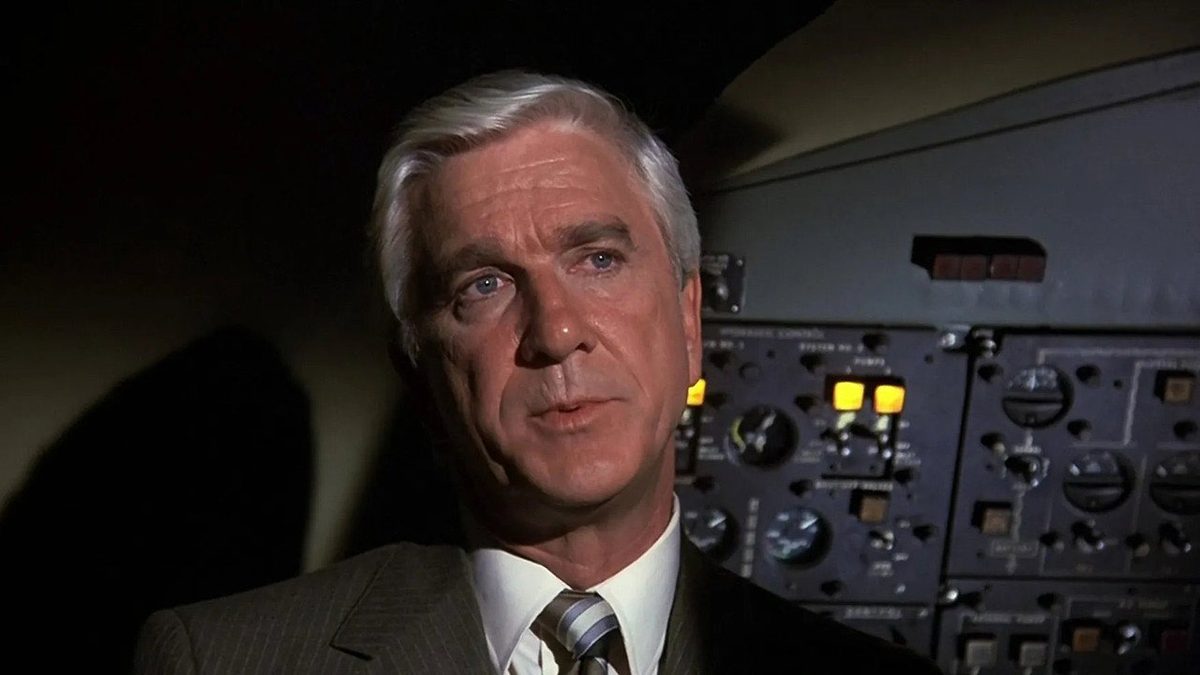
When Leslie Nielsen enters the cockpit of Trans American Flight 209 and delivers the immortal exchange—“Surely you can’t be serious.” / “I am serious. And don’t call me Shirley.”—he delivers the line with the chilling solemnity of a cardiologist diagnosing a terminal patient.
The ZAZ Axiom: The Serious Face Rule
In pure parody, the joke belongs entirely to the audience, never to the characters. The moment an actor laughs at their own dialogue or acknowledges the absurdity of their universe, the spell is broken. The world of the film must treat its nonsense as a matter of urgent life and death.
As we explored in our analysis of deadpan absurdism and modern comedic mechanics, comedy reaches its highest velocity when performers refuse to break character. Nielsen understood that playing Lt. Frank Drebin in The Naked Gun wasn’t about being funny; it was about being an intensely sincere, deeply incompetent detective who genuinely believed he was saving the Queen of England.
Rule #2: The Three-Track Visual Polyphony
What makes Airplane! and The Naked Gun infinitely rewatchable is that a single frame of film frequently contains three independent jokes occurring simultaneously:
- Track 1 (Foreground Audio): High-stakes, straight-faced dramatic exposition delivered without inflection.
- Track 2 (Midground Action): Absurd physical business performed in deadpan silence (e.g., Rex Kramer sweating water from a garden hose, or Dr. Rumack checking a patient’s heart with a stethoscope that dangles to the floor).
- Track 3 (Background Sight Gag): Visual anarchy taking place in deep focus that the main characters completely ignore (e.g., terminal monitors displaying flight departures that say “BANGKOK / TOKYO / CANCELLED / DOOMED”, or a portrait of the Pope on the wall that suddenly turns its eyes).
Consider the airport terminal sequence in Airplane!. While two characters hold a serious conversation about emotional estrangement in the foreground, the background public address system descends into a vicious domestic argument between two automated female announcers arguing over whether the red zone or white zone is for loading and unloading passengers, eventually escalating into accusations of infidelity and an abortion clinic debate.
The Zero Hour! Heist: Airplane! is not an original narrative; it is almost a line-by-line remake of Zero Hour!, a forgotten 1957 black-and-white airline thriller written by Arthur Hailey. ZAZ bought the remake rights for \$2,500 and lifted entire pages of Hailey's melodramatic script verbatim. Because the dramatic spine was already engineered as a functional disaster thriller, the jokes could hang securely from a bulletproof narrative skeleton.
Rule #3: The Literalized Idiom
Much of the comedic DNA of ZAZ traces back to their live sketch roots in Wisconsin and Los Angeles (a creative evolution we traced in our history of collegiate sketch comedy and writers’ rooms).
At the Kentucky Fried Theater, the trio developed a signature verbal technique: taking common colloquialisms and rendering them violently, hilariously literal.
- “What’s our vector, Victor?”
- “Give me a runway!” (Cuts to an air traffic controller strutting like a Parisian haute couture model).
- “The shit’s hit the fan!” (Cuts to an actual oscillating desk fan getting blasted with fresh manure).
- “Nice beaver!” / “Thank you. I just had it stuffed.” (Frank Drebin admiring a woman holding a literal taxidermy mammal).
By dragging figurative English into physical reality, ZAZ exposed the inherent absurdity of human language itself.
Rule #4: The Propulsive Narrative Skeleton
The fatal flaw of modern spoof movies like Scary Movie or Haunted House is that they lack an internal engine. They are merely a loose compilation of vignettes stitched together with flimsy excuses to transition from one parody to the next.
Airplane! and The Naked Gun never suffered from this weakness because their plots were airtight. In Airplane!, the plane genuinely will crash if Ted Striker cannot overcome his wartime trauma and land the aircraft. In The Naked Gun, a foreign terrorist genuinely is attempting to assassinate Queen Elizabeth II at Dodger Stadium.
Because the stakes are real within the internal logic of the universe, every gag operates under compression. The comedy doesn’t halt the narrative; it rides on top of it like a runaway train.
The Blueprint for a Comedy Renaissance
In an era saturated with streaming comedies that often feel sluggish, improvised, and bloated, the works of Zucker, Abrahams, and Zucker stand as monuments to cinematic craftsmanship.
They proved that true spoofing is not the lowest form of humor, but the highest: a clockwork apparatus requiring surgical editing, fearless straight-man performances, and an unshakeable respect for the intelligence of the audience.
If comedy is ever to reclaim its theatrical throne, modern filmmakers would do well to study the gospel of Dr. Rumack, throw out their disposable pop-culture references, look straight down the barrel of the camera without blinking, and remember: the straighter the face, the louder the laugh.