
In the summer of 1989, Larry David and Jerry Seinfeld pitched a modest half-hour comedy about how a stand-up comedian gathers his material. Over the next nine seasons and 180 episodes, Seinfeld dismantled five decades of wholesome television tradition, establishing a ruthless creative philosophy that redefined American culture: “No hugging, no learning.”
There were no tearful third-act reconciliations, no moral lessons, and zero personal growth. The characters were petty, narcissistic, gossipy, and obsessed with minutiae—the placement of buttons, double-dipping potato chips, low-flow showerheads, and whether someone was “sponge-worthy.”
Yet what made this universe immortal was its staggering bench of talent. From the Core Four sitting in Monk’s Diner booths to the volatile sociopaths lurking on the sidewalks of Manhattan, the Seinfeld characters populated the richest comedic ecosystem ever broadcast.
Much like the unrepentant narcissism that fueled the Arrested Development cast and the awkward social friction of The Office cast, the denizens of Seinfeld never apologized for who they were.
Here is the definitive critical ranking of the 15 best Seinfeld characters of all time.
15. Kenny Bania (Steve Hytner)
- First Appearance: Season 6, Episode 7 (“The Soup”)
- The Dynamic: The hack comedian whose simple-minded enthusiasm drives Jerry insane
- Iconic Routine: “The jar is round, the mug is round… it’s gold, Jerry! Gold!”
Kenny Bania represents every mediocre artist who stumbles into unearned success. A hack stand-up whose entire repertoire consists of observational questions about Ovaltine and Risk management, Bania attaches himself to Jerry like an inescapable, smiling leech.
Steve Hytner played Bania’s wide-eyed, toothy optimism with sublime comedic vanity. The running gag of Bania demanding a meal at Mendy’s in exchange for an Armani suit—only to order soup and insist soup doesn’t count as a meal—is pure Davidian social torture. Watching Jerry squirm while Bania gleefully orders swordfish is comedic gold.
14. Uncle Leo (Len Lesser)
- First Appearance: Season 2, Episode 2 (“The Pony Remark”)
- The Dynamic: Aggressive guilt trips, braggadocious pride in his son Jeffrey, and shoplifting batteries
- Iconic Greeting: “Jerry! Hello!”
Uncle Leo is the distilled essence of every overbearing, guilt-tripping relative in New York. Grabbing Jerry’s arm with a vice-like grip whenever they cross paths on the street, Leo exists solely to demand conversational validation and boast about his son Jeffrey’s minor career achievements in the New York City Parks Department (“He works for the Parks Department, Jerry! He’s in the blooming orchids division!”).
Len Lesser brought unforgettable manic intensity to Leo. Whether having fake eyebrows drawn on with a Sharpie by Elaine—giving him an expression of permanent, furious agitation—or getting arrested for stealing a watch at a department store, Leo treated the entire world as an anti-Semitic conspiracy designed to deny him his due respect.
13. David Puddy (Patrick Warburton)
- First Appearance: Season 6, Episode 21 (“The Fusilli Jerry”)
- The Dynamic: Monosyllabic, deadpan grease monkey with an 8-ball jacket and zero interior doubt
- Iconic Declaration: “Yeah, that’s right.”
Before Patrick Warburton became a voice acting legend, he created an indelible deadpan icon in David Puddy. Elaine’s on-again, off-again mechanic boyfriend, Puddy was a man completely devoid of neurosis. He sat on airplanes staring blankly at the back of the seat in front of him, loved high-fiving strangers, and ate Arby’s with religious devotion.
Warburton’s delivery was hypnotic: a flat, deep baritone that refused to engage with Elaine’s manic urban panic. When Puddy paints his face red and black to scream at priests as a rabid New Jersey Devils fan (“Gotta support the team!”), he became one of the show’s most beloved recurring stars.
12. Jackie Chiles (Phil Morris)
- First Appearance: Season 7, Episode 3 (“The Maestro”)
- The Dynamic: Hyper-verbal, alliterative legal crusader continually undone by Kramer’s incompetence
- Iconic Summation: “It’s outrageous, egregious, preposterous!”
A pitch-perfect parody of legendary defense attorney Johnnie Cochran, Jackie Chiles is the only lawyer in Manhattan willing to take Cosmo Kramer’s utterly nonsensical lawsuits.
Phil Morris delivered Jackie’s dialogue with breathtaking cadence, firing off triplets of rhythmic adjectives without taking a breath. The comedy stems from Jackie’s mounting agony as Kramer repeatedly sabotages their foolproof cases: putting a hot coffee cup in his lap, trying on a leather bra that doesn’t fit (“A bra’s gotta fit right against the skin, like a glove!”), or applying balm to a burn without medical supervision (“Who told you to put the balm on? Did the doctor tell you to put the balm on?!”).
11. J. Peterman (John O’Hurley)
- First Appearance: Season 6, Episode 23 (“The Understudy”)
- The Dynamic: Melodramatic adventurer and poetic dictator of consumer catalog prose
- Iconic Prose: “The morning mist had barely cleared when the rogue elephant charged…”
Modeled after real-life clothing entrepreneur John Peterman, John O’Hurley turned J. Peterman into a Victorian explorer trapped in a 1990s Madison Avenue office. Speaking exclusively in sweeping, baroque theatrical monologues about opium dens in Shanghai and linen pants in Burma, Peterman treats daily corporate life as an international expedition.
O’Hurley’s booming, Shakespearean voice provided the perfect foil for Elaine’s mounting exasperation as his catalog editor. From firing George for refusing to reveal his ATM code (“Bosco!”) to eating King Edward VIII’s antique wedding cake, Peterman was delightfully, magnificently unhinged.
10. The Soup Nazi / Yev Kassem (Larry Thomas)
- First Appearance: Season 7, Episode 6 (“The Soup Nazi”)
- The Dynamic: The iron-fisted culinary dictator of West 55th Street
- Iconic Verdict: “No soup for you!”
Inspired by real-life soup vendor Al Yeganeh, Larry Thomas appeared in exactly two episodes of Seinfeld, yet his performance created one of the most famous catchphrases in modern television history. Yev Kassem was a culinary genius whose mulligatawny and crab bisque were so transcendent that New Yorkers willingly subjected themselves to military regimentation to buy a bowl.
Thomas played the character not as a cartoon, but with terrifying, operatic discipline: step to the left, have your money ready, and never make small talk. When George complains about not getting bread, or Elaine attempts to dance in line, the verdict is swift and merciless: “No soup for you! Come back, one year!”
9. Estelle Costanza (Estelle Harris)
- First Appearance: Season 4, Episode 11 (“The Contest”)
- The Dynamic: Piercing, operatic maternal disappointment and shrieking marital warfare
- Iconic Trauma: Catching George with a Glamour magazine
If George Costanza was an emotional wreck, his mother Estelle was the architect of the demolition. Estelle Harris possessed a voice like a sonic boom of Jewish guilt, capable of escalating from a gentle whisper to a glass-shattering shriek in half a syllable.
Whether bickering with husband Frank over paella, refusing to ride in a car because she doesn’t like George’s driving, or passing out on the floor after catching George treating his body “like an amusement park”, Estelle was a comedic hurricane. Her inability to understand George’s choices gave the series some of its most explosive family dinners.
8. Frank Costanza (Jerry Stiller)
- First Appearance: Season 5, Episode 2 (“The Puffy Shirt”)
- The Dynamic: Volcanic, unpredictable patriarch of absurd inventions and repressed fury
- Iconic Holiday: Festivus for the Rest of Us
Originally played by John Randolph for a single episode before Jerry Stiller took over, Frank Costanza is one of the greatest character transformations in sitcom history. Stiller turned Frank into a powder keg of inexplicable eccentricities, unpredictable pauses, and sudden bursts of thunderous rage.
Frank was a walking repository of madcap inventions: * The Manssiere / The Bro: A supportive undergarment for men with large chests. * Stop-Shorting: A dangerous vehicular flirtation technique. * Festivus: A non-commercial winter holiday featuring an unadorned aluminum pole, the Airing of Grievances, and the Feats of Strength.
Stiller screaming “Serenity now… insanity later!” while clutching his temples gave television one of its most quoted comedic mantras.
7. Susan Ross (Heidi Swedberg)
- First Appearance: Season 4, Episode 1 (“The Trip: Part 1”)
- The Dynamic: The wealthy, patient straight woman trapped in George’s web of doom
- Iconic Demise: Licking cheap, toxic wedding invitation envelopes
Susan Ross was the ultimate straight woman in the Seinfeld universe—a sensible NBC executive whose life was systematically destroyed simply by associating with George Costanza. Over four seasons, George ruined her job, burned down her family’s cabin, threw her girlfriend into a lesbian crisis, and reluctantly proposed to her out of peer pressure.
Heidi Swedberg played Susan with tragic, grounded dignity. Because the four leads struggled to connect with her character’s grounded rhythm, Larry David made the historic decision to kill her off via cheap, toxic envelope glue. The Core Four’s reaction at the hospital—a brief shrug followed by an invitation to get coffee—cemented the show’s legacy of absolute, unapologetic sociopathy.
6. Newman (Wayne Knight)
- First Appearance: Season 3, Episode 15 (“The Suicide”)
- The Dynamic: The portly, Machiavellian mailman and Jerry’s mortal nemesis
- Iconic Greeting: “Hello, Jerry.” / “Hello, Newman.”
Wayne Knight turned Newman—an overweight, poetry-quoting United States postal worker—into one of the greatest villains in sitcom history. Operating out of apartment 5E, Newman was pure, operatic malice disguised in a blue uniform: “When you control the mail, you control information!”
The chemistry between Knight and Jerry Seinfeld crackled with superhero-level hatred. Newman viewed Jerry as a smug, pampered dilettante, while Jerry viewed Newman as pure, unadulterated evil. Whether attempting to smuggle Michigan recycling bottles with Kramer, sweating under interrogation over a stolen muffin-stump route, or fleeing a flea-infested apartment, Newman brought Shakespearean theatricality to everyday New York pettiness.
5. Jerry Seinfeld (Jerry Seinfeld)
- Portrayed by: Jerry Seinfeld
- The Dynamic: The detached, clean-freak observational hub around which the madmen spin
- Iconic Philosophy: “Even-Steven”
Because Jerry Seinfeld was not a trained actor, early critics often overlooked his performance. But Jerry was the indispensable anchor holding the entire machine together. Playing a fictionalized version of himself, Jerry was the only character who was financially stable, emotionally unbothered, and reasonably well-adjusted.
Jerry viewed his life not as a participant, but as a spectator watching an avant-garde comedy. His obsessive compulsions—eating cereal at all hours, scrubbing bathroom tiles, analyzing Superman lore, and breaking up with women for ridiculous reasons (man-hands, eating peas one at a time, having a annoying laugh)—established the show’s observational grammar. Jerry’s serene indifference allowed George, Elaine, and Kramer to detonate around him without derailing the show.
4. Cosmo Kramer (Michael Richards)
- Portrayed by: Michael Richards
- The Dynamic: The hipster doofus, physical comedy virtuoso, and freeloading neighbor
- Iconic Entrance: Sliding through Jerry’s apartment door at terminal velocity
Michael Richards won three Primetime Emmy Awards for Cosmo Kramer, delivering a tour de force of physical comedy unmatched since Buster Keaton and Jacques Tati. Kramer did not enter a room; he exploded into it, sliding across hardwood floors, tripping over rugs, and popping his eyes with electrified shock.
Kramer lived entirely on instinct, devoid of a visible job, bank account, or social filter. He fell backward into millions, seduced women with his mystical “Kavorka” animal magnetism, and launched harebrained entrepreneurial ventures: the coffee table book about coffee tables (with fold-out legs), the make-your-own-pizza restaurant, and the Kramerica Industries oil tanker bladder. Richards committed with feral intensity, turning a freeloading neighbor into an immortal comic force.
3. Elaine Benes (Julia Louis-Dreyfus)
- Portrayed by: Julia Louis-Dreyfus
- The Dynamic: Pushy, fiercely intelligent urban feminist battling social hypocrisies
- Iconic Physicality: The two-handed chest shove (“GET OUT!”) and the “Little Kicks” dance
Julia Louis-Dreyfus won an Emmy and transformed female comedic acting forever as Elaine Benes. Introduced in episode two because network executives demanded a female voice in the room, Elaine refused to be the sweet girlfriend or the voice of reason. She was just as petty, selfish, and ruthless as the men.
Louis-Dreyfus brought volcanic physical energy and lightning verbal timing to the role. Whether judging potential lovers against her strict “sponge-worthy” checklist, throwing George’s toupee out a third-story window (“I DON’T LIKE THIS THING AND HERE’S WHAT I’M DOING WITH IT!”), or dancing like a full-body dry-heave set to music, Elaine was a force of urban nature. Her sharp comedic ferocity paved the way for every complex television heroine that followed.
2. The Genius of the Core Four
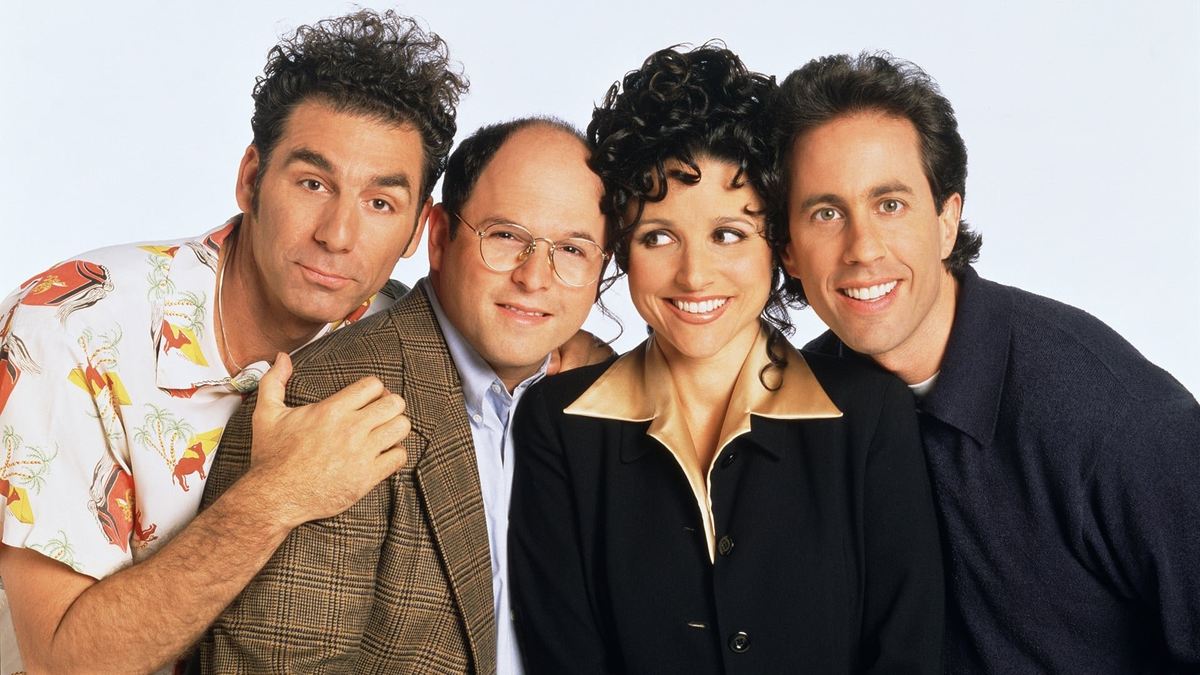
Before naming the top spot, it is vital to recognize why the four leads functioned as a single comedic organism. What Larry David and Jerry Seinfeld achieved was a four-part harmony of neurosis: * Jerry: The detached intellect who observes the absurdity. * Elaine: The frustrated ego who demands society make sense. * Kramer: The untamed id who acts entirely on primal impulse. * George: The anxious, suffering soul who represents our worst impulses.
Together, their conversations at Monk’s Cashier counter or waiting for a table in a Chinese restaurant turned the mundane realities of adult life into high art.
1. George Costanza (Jason Alexander)
- Portrayed by: Jason Alexander
- The Defining Achievement: The greatest comedic character in the history of American television
- Iconic Mantra: “It’s not a lie if you believe it.”
There was never any question. George Louis Costanza is not merely the greatest Seinfeld character; he is the undisputed summit of television comedy—a balding, short, stocky, slow-witted, scheming sociopath whose life was an operatic masterclass in self-sabotage.
Based directly on co-creator Larry David, George represented humanity’s darkest, pettiest impulses brought to life by the virtuosic Broadway craft of Jason Alexander. Alexander approached George not as a caricature, but as a tragic hero battling an unfair universe.
George’s rap sheet of comic depravity is endless: * Inventing a fake architectural career under the alias Art Vandelay. * Pushing children and grandmothers out of the way to escape a minor kitchen fire. * Transforming his life by doing the exact opposite of every natural instinct (“The Opposite”). * Sleeping under his desk at Yankee Stadium with custom fitted cabinetry. * Feigning a physical handicap to secure a private executive restroom.
When George delivers his legendary speech to Jerry—“Jerry, just remember. It’s not a lie… if you believe it”—he wasn’t just giving advice; he was summarizing the human condition. George Costanza is a masterpiece of comedic acting and psychological writing that will never be surpassed.