
“Now the story of a wealthy family who lost everything, and the one son who had no choice but to keep them all together.”
When Mitchell Hurwitz’s Arrested Development debuted on Fox in the autumn of 2003, it detonated the traditional three-camera, studio-audience sitcom model. Employing handheld documentary cameras, rapid-fire cutaways, intricate background callbacks, and the omniscient, deadpan narration of Ron Howard, the series demanded an attentive audience.
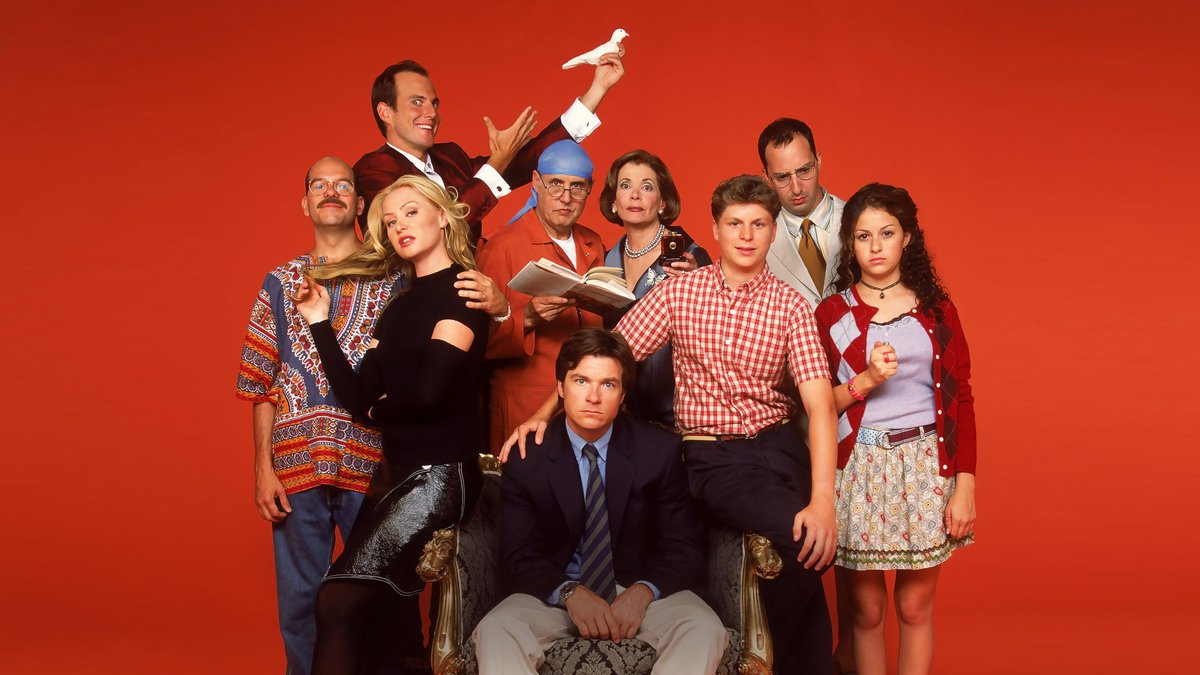
Yet all the narrative structural brilliance would have meant nothing without the Arrested Development cast. Assembled with surgical precision, the ensemble portrayed the Bluth family—a cabal of entitled, emotionally stunted, corrupt real-estate grifters in Orange County, California—with ferocious comedic commitment. They were monsters, yet their desperate, childish need for approval made them impossible not to love.
Much like the selfish neuroses that powered the greatest Seinfeld characters, the cult genius of the Community cast, and The Office cast, every member of the Bluth orbit had a distinct comedic frequency.
Here is the definitive critical ranking of the 10 best characters from the Arrested Development cast.
10. Barry Zuckerkorn (Henry Winkler)
- Portrayed by: Henry Winkler
- The Dynamic: Incompetent legal representation with terrible boundary awareness
- Iconic Catchphrase: “He’s very good!”
Casting the Fonz himself as the Bluth family’s utterly hopeless attorney was a stroke of meta-comedy genius. Barry Zuckerkorn is a man who went to law school in the Virgin Islands, regularly meets clients in highway rest stops, and consults legal textbooks while eating fast-food pancakes.
Henry Winkler played Barry’s professional negligence with sunny, oblivious cheer. Whether accidentally jumping a dead shark on a pier in a nod to Happy Days or advising Michael to commit multiple felonies to cover up financial fraud, Winkler never played Barry as malicious—he was simply incompetent. His frequent legal summations (“Those are balls”) delivered some of the loudest laughs in the show’s run.
9. Maeby Fünke (Alia Shawkat)
- Portrayed by: Alia Shawkat
- The Dynamic: Precocious con artist thriving under chronic parental neglect
- Iconic Scheme: Accidentally running a Hollywood movie studio under the alias “Marry Featherbottom”
In a household where parents Tobias and Lindsay were hopelessly obsessed with their own vanity, Maeby survived by becoming a generational grifter. Rather than begging for attention, Maeby weaponized her invisibility, forging report cards, stealing charity funds, and eventually posing as a high-powered film executive at Tantamount Studios.
Alia Shawkat played Maeby with world-weary swagger and dry comedic timing. Watching a 15-year-old girl manipulate Hollywood producers, greenlight terrible blockbusters (Dangerous Cousins), and casually order triple espressos while her parents remained completely clueless was a masterclass in teenage satire.
8. George Michael Bluth (Michael Cera)
- Portrayed by: Michael Cera
- The Dynamic: Paralyzing moral anxiety colliding with an agonizing teenage crush
- Iconic Role: Mr. Manager of the frozen banana stand
Long before Superbad and Juno made him a household name, Michael Cera established the blueprint for his stuttering, awkward screen persona as George Michael Bluth. The only Bluth child raised with an active conscience, George Michael was crushed under the impossible expectations of his father, Michael, and an illicit infatuation with his cousin, Maeby.
Cera’s physical comedy was sublime: the nervous throat clears, the gentle shuffle away from conflict, the woodblock rehearsals, and the desperate dedication to running the family banana stand (“We just say ‘manager,’ buddy”). George Michael was the sweet, fragile soul constantly caught in the collateral damage of his family’s moral bankruptcy.
7. Lindsay Bluth Fünke (Portia de Rossi)
- Portrayed by: Portia de Rossi
- The Dynamic: Narcissistic virtue signaling masking acute consumerist materialism
- Iconic Cause: “Hands Off Our Penises” and “Save the Wetlands”
Lindsay Bluth represented the pinnacle of superficial Newport Beach activism. Adopted into the family as a competitive counterweight to her siblings, Lindsay dedicated her life to protesting social injustices—provided the protest allowed her to wear expensive designer sunglasses and didn’t interfere with her salon appointments.
Portia de Rossi attacked the role with fearless comic vanity. Whether preparing an entire banquet out of “hot ham water,” competing with her daughter for the attention of high school boys, or staying in a disastrous marriage purely out of spite, de Rossi’s deadpan narcissism was endlessly hilarious.
6. Michael Bluth (Jason Bateman)
- Portrayed by: Jason Bateman
- The Dynamic: The self-righteous straight man who is secretly just as flawed as the rest
- Iconic Reaction: Deadpan stares directly into the camera lens
Jason Bateman earned a Golden Globe and Emmy nominations for anchoring the chaos as Michael Bluth. For the first two seasons, audiences viewed Michael as the heroic moral compass—the widowed, hardworking brother sacrificing his sanity to save his corrupt family from federal prison.
The genius of Hurwitz’s writing and Bateman’s performance, however, was the slow realization that Michael was just as vain, stubborn, and controlling as his parents. He stayed not because they forced him, but because he was addicted to feeling superior to them. Bateman’s quiet reactions, muttered sighs, and flawless comic timing made him the greatest straight man of his era—a masterclass he later brought to the big screen leading the This Is Where I Leave You cast.
5. George Bluth Sr. (Jeffrey Tambor)
- Portrayed by: Jeffrey Tambor
- The Dynamic: Corrupt real-estate patriarch running dynasties from orange jumpsuits and attics
- Iconic Revelation: “There’s always money in the banana stand!”
Jeffrey Tambor brought booming baritone authority and petty greed to George Bluth Sr., the developer who built defective tract housing in Orange County (and illegally in Iraq). Indicted for defrauding investors, George spent the series bouncing between county jail, hiding in the model home attic, and running religious scams with ice-cream sandwiches.
Tambor also pulled double duty as George’s identical twin brother Oscar, a stoned, long-haired hippie whose unrequited love for Lucille yielded constant comedy. Tambor’s physical commitment—from teaching his children lessons with a one-armed man to whispering theological advice behind the attic air vents—was comic wizardry.
4. Buster Bluth (Tony Hale)
- Portrayed by: Tony Hale
- The Dynamic: Coddled, juice-box-drinking mama’s boy with explosive panic attacks
- Iconic Evolution: Replacing his severed hand with a terrifying chrome hook (“I’m a monster!”)
Buster Bluth is one of the most eccentric, physically expressive comic creations in television history. A 32-year-old perpetual student who spent decades studying 18th-century agrarian business and Native American drumming, Buster was pathologically attached to his mother, Lucille.
Tony Hale brought manic, bird-like physical mannerisms to Buster: the frantic blinking, the sudden shrieks of joy, the terrifying sugar rushes on boxed apple juice, and his iconic meltdown after a “loose seal” bit off his left hand. Hale won two Primetime Emmy Awards for playing a man-child whose sudden bursts of rage (“You’re killing me, Buster!”) were as shocking as they were hilarious.
3. Tobias Fünke (David Cross)
- Portrayed by: David Cross
- The Dynamic: World’s first “analrapist,” aspiring actor, and terminal never-nude
- Iconic Misunderstanding: Oblivious delivery of staggering, nonstop double entendres
David Cross took a character that looked impossible on paper and turned him into an immortal television icon. Dr. Tobias Fünke was a disgraced chief of psychiatry who abandoned medicine to pursue an acting career, despite possessing zero talent.
Tobias’ comedic profile was a hurricane of bizarre conditions: he was a medically diagnosed “never-nude” who wore cutoff jean shorts under everything, spent entire seasons painted head-to-toe in blue body paint to join the Blue Man Group, and routinely phrased every innocent thought in devastatingly suggestive innuendo (“I’m afraid I prematurely shot my wad on what was supposed to be a dry run”). Cross committed with ferocious, shameless sincerity, making Tobias a titan of cringe comedy.
2. Gob Bluth (Will Arnett)
- Portrayed by: Will Arnett
- The Dynamic: Failed stage magician, Segway rider, and king of catastrophic decisions
- Iconic Catchphrase: “I’ve made a huge mistake.”
George Oscar Bluth II (Gob, pronounced “Jobe”) was television’s premier strutting, insecure peacock. Played with gravel-voiced bravado by Will Arnett, Gob was a professional magician who was repeatedly banned from the Magicians Alliance for revealing trade secrets (“Illusion, Michael. A trick is something a whore does for money”).
Arnett turned Gob into an operatic clown. Riding through suburban streets on a motorized Segway, dancing frantically to Europe’s “The Final Countdown” while biting a playing card, dropping dead doves out of his sleeves, and whistling through his teeth, Gob was a walking catastrophe. His instantaneous shifts from arrogant swagger to pathetic, tearful regret (“I’ve made a huge mistake”) represent some of the funniest character beats in television history.
1. Lucille Bluth (Jessica Walter)
- Portrayed by: Jessica Walter
- The Defining Achievement: The greatest, most lethal matriarch in television comedy history
- Iconic Line: “I mean, it’s one banana, Michael. What could it cost, ten dollars?”
There was never any question. The late, magnificent Jessica Walter delivered a performance for the ages as Lucille Bluth—the vodka-swilling, diamond-wearing, remorseless queen of the Bluth dynasty.
Lucille treated parenting as an Olympic bloodsport. With an arched eyebrow, a tilted martini glass, and a wink that looked like a facial spasm, Walter delivered surgical insults with aristocratic elegance (“I don’t care for Gob”, “Here’s some money, go see a Star War”). She had zero understanding of how the real world functioned, yet manipulated every child and husband like chess pieces on a board.
Walter never softened Lucille for the audience. She embraced her character’s monstrous vanity, passive-aggressive cruelty, and financial gluttony with radiant joy. Lucille Bluth is not just the finest character in Arrested Development; she is one of the single greatest comedic performances in the history of American television.