
In October 1969, six young Oxbridge graduates—Graham Chapman, John Cleese, Terry Gilliam, Eric Idle, Terry Jones, and Michael Palin—unleashed Monty Python’s Flying Circus on late-night BBC. Rejecting traditional punchlines in favor of stream-of-consciousness non-sequiturs, stream-of-consciousness animation, and intellectual absurdity, the troupe dismantled the grammar of broadcast television forever.
Yet it was when the Pythons transitioned to the cinema screen that their cultural immortality was guaranteed. Moving beyond 30-minute television constraints, the troupe revolutionized narrative satire, historical deconstruction, and cinematic parody.
Much like the foundational comedic masterworks we celebrated across our ranking of the 15 best spoof movies of all time, Monty Python’s filmography succeeded because they never treated absurdity as a shortcut. Every film possessed meticulous historical production design, authentic mud, sweeping classical orchestration, and an unyielding commitment to intellectual silliness.
Here is the definitive critical ranking of the best Monty Python movies, counted down from good to transcendent.
5. And Now for Something Completely Different (1971)
- Director: Ian MacNaughton
- Key Sketches: The Dead Parrot, The Lumberjack Song, Hell’s Grannies, Upper Class Twit of the Year
- The Mission: Converting American moviegoers to British surrealism on a shoestring budget
Financed by Playboy executive Victor Lownes to introduce American cinema audiences to the Pythons before the BBC television series had secured wide overseas syndication, And Now for Something Completely Different is a 90-minute anthology of re-shot sketches from the first two television seasons.
Because the troupe had to recreate sketches on a micro-budget in an abandoned dairy building, some performances lack the chaotic spontaneity of their original television broadcasts. Nevertheless, as a concentrated greatest-hits compilation, the film is an astonishing comedic artillery barrage.
Watching John Cleese storm into Michael Palin’s pet shop brandishing a deceased Norwegian Blue (“He’s not pinin’! He’s passed on! This parrot is no more!”), or witnessing upper-class aristocrats attempt to jump over boxes of matches in the “Upper Class Twit of the Year” obstacle course, is a masterclass in physical timing. It remains the essential crash course in early Python absurdity.
4. Monty Python Live at the Hollywood Bowl (1982)
- Director: Terry Hughes
- Key Sketches: The Four Yorkshiremen, The Bruces, Ministry of Silly Walks, The Argument Clinic
- The Mission: Proving the troupe’s comedic theatricality before 17,000 screaming rock-and-roll fans
Filmed across four sold-out nights in Los Angeles in September 1980, Live at the Hollywood Bowl captures the Pythons at the height of their international rock-star status. Surrounded by 17,000 delirious fans reciting lines in unison, the troupe performed a career-spanning revue of their greatest sketches alongside filmed interludes.
What makes the concert film so electrifying is the troupe’s infectious delight in corpsing and ad-libbing. Graham Chapman and John Cleese deliver a blistering, lightning-fast performance of “The Argument Clinic,” while the iconic “Four Yorkshiremen” sketch—four tuxedo-wearing millionaires puffing cigars while competing to describe who had the most destitute childhood (“We used to live in a cardboard box in middle of t’ road!”)—achieved its definitive comedic timing on this stage. It is an indispensable historical document of comic legends feeding on the raw energy of a stadium crowd.
3. Monty Python’s The Meaning of Life (1983)
- Directors: Terry Jones, Terry Gilliam
- Key Vignettes: “Every Sperm Is Sacred”, Mr. Creosote, The Autumn Years, The Galaxy Song
- The Mission: Dissecting human birth, biology, corporate rot, and death through operatic horror
The troupe’s final full cinematic collaboration was also their darkest, most visually extravagant, and visceral production. Abandoning the singular narrative spine of their previous two features, The Meaning of Life returns to an episodic anthology structure, tracking the human lifecycle from birth to the grave.
The film contains some of the most breathtaking visual satire in cinema history. “Every Sperm Is Sacred”—a sweeping, full-scale musical parody of Oliver!-style Victorian workhouses—is a dazzling deconstruction of theological dogma. Terry Gilliam’s standalone short The Crimson Permanent Assurance, depicting elderly accountants mutinying like 17th-century pirates against modern financial skyscrapers, is a visual tour de force.
And, of course, there is Mr. Creosote (Terry Jones), the gargantuan French restaurant patron who consumes staggering mountains of gourmet food before an obliging maître d’ (John Cleese) offers a “wafer-thin mint”, triggering an apocalyptic explosion of cinematic bile. Uncompromising, grotesque, and profoundly philosophical, the film confronts the terror of human insignificance with defiant laughter.
2. Monty Python and the Holy Grail (1975)
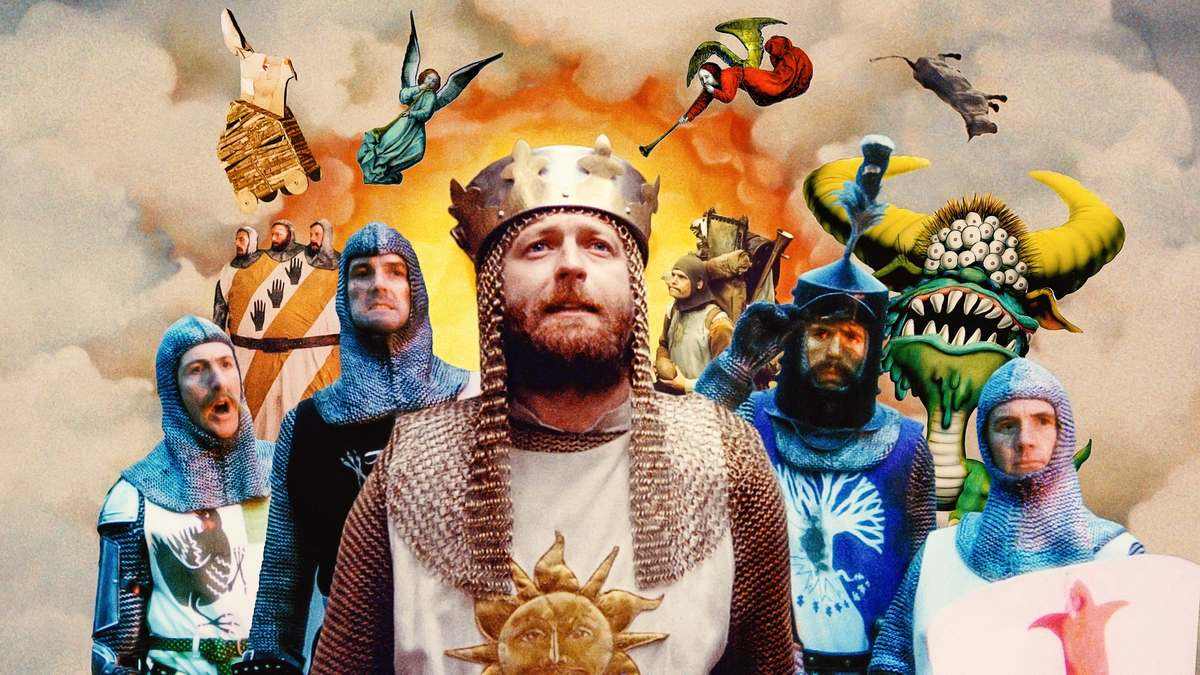
- Directors: Terry Gilliam, Terry Jones
- Key Characters: King Arthur, Sir Lancelot, The Black Knight, The French Taunter, Tim the Enchanter
- The Mission: Rewriting medieval Arthurian romance with mud, coconuts, and lethal killer rabbits
Shot on location in the damp, freezing Highlands of Scotland with funds raised from rock legends Pink Floyd, Genesis, and Led Zeppelin, Monty Python and the Holy Grail is universally acknowledged as one of the greatest spoof movies ever created.
Faced with a budget so minuscule they could not afford horses, the Pythons made a legendary creative compromise: having their actors gallop on foot while porters clacked empty coconut shells behind them (“You’ve got two empty halves of coconut and you’re bangin’ ‘em together!”). That necessity birthed a comedy style where mundane logistical debates repeatedly derail epic heroic mythology.
Every single sequence is etched into comedy folklore: * The Black Knight (John Cleese): Refusing to yield to King Arthur despite having all four limbs severed (“It’s just a flesh wound! I’ll bite your legs off!”). * The French Castle Taunter (John Cleese): Hurling livestock over battlements while barking exquisite insults (“Your mother was a hamster, and your father smelt of elderberries!”). * The Knights Who Say “Ni!”: Terrifying woodland guardians subdued only by shrubberies and the forbidden word “it.” * The Killer Rabbit of Caerbannog: A vicious, fanged white bunny that decapitates valiant armored knights in mid-air.
By ending with modern 1970s police squad cars screeching onto the battlefield to arrest King Arthur for the murder of a television historian, Holy Grail proved that the troupe had zero interest in Hollywood narrative conformity. It is an unassailable triumph of pure comic invention.
1. Monty Python’s Life of Brian (1979)
- Director: Terry Jones
- Key Characters: Brian Cohen, Mandy Cohen, Pontius Pilate, Biggus Dickus, Reg
- The Mission: The sharpest, most humane religious and political satire in cinematic history
There was never any debate. Monty Python’s Life of Brian is not merely the finest Monty Python film; it is one of the greatest satires ever recorded on celluloid—a flawless, courageous masterpiece that was nearly extinguished before a single frame was shot.
Days before production began in Tunisia, EMI Films head Lord Delfont read the script and pulled financing, deeming it blasphemous. Former Beatle George Harrison, an ardent Python obsessive, mortgaged his London mansion and office to fund the £2 million budget simply because, as Eric Idle famously remarked, “He wanted to see the movie.” Harrison’s production company, HandMade Films, was born, saving British cinema.
Set in Judea in 33 A.D., the film tracks Brian Cohen (Graham Chapman in his finest screen performance), an ordinary Jewish youth born in the stable next door to Jesus who is continually, accidentally mistaken for the Messiah.
Crucially, the film never mocks Jesus Christ or faith itself; instead, it delivers a blistering, razor-sharp indictment of human dogmatism, sheep-like flock mentalities, and hypocritical political factionalism. The constant bickering among revolutionary underground movements—the People’s Front of Judea, the Judean People’s Front, and the Popular Front—remains the single most accurate deconstruction of political infighting ever conceived.
From Terry Jones as Brian’s screeching mother Mandy (“He’s not the Messiah, he’s a very naughty boy!”) to Michael Palin’s lisping Pontius Pilate testing the Roman guards’ composure with “Biggus Dickus,” the film operates with flawless comedic precision.
And its climax—a choir of condemned men whistling “Always Look on the Bright Side of Life” while hanging on crosses under a blazing Mediterranean sky—is cinema’s ultimate testament to human optimism. In the face of political tyranny, religious zealotry, and inevitable mortality, laughter remains our only divine salvation.
The Undying Legacy of Monty Python
Monty Python’s films outlast the centuries because they attacked targets that never go out of style: pomposity, authority, hypocrisy, and bureaucratic decay. By combining high-minded intellectual literary literacy with joyous, low-brow schoolboy silliness, six men armed with coconuts and cardboard monsters created a comedic vocabulary that continues to shape every generation of satirists that follows.