
When the 2020 Sundance Film Festival wrapped in late January, the biggest headline in American independent cinema belonged to a deceptively sunny romantic comedy. Neon and Hulu acquired worldwide rights to director Max Barbakow and screenwriter Andy Siara’s debut feature Palm Springs for exactly $17,500,000.69—beating the previous all-time festival record (The Birth of a Nation) by precisely sixty-nine cents, a quintessential Lonely Island punchline.
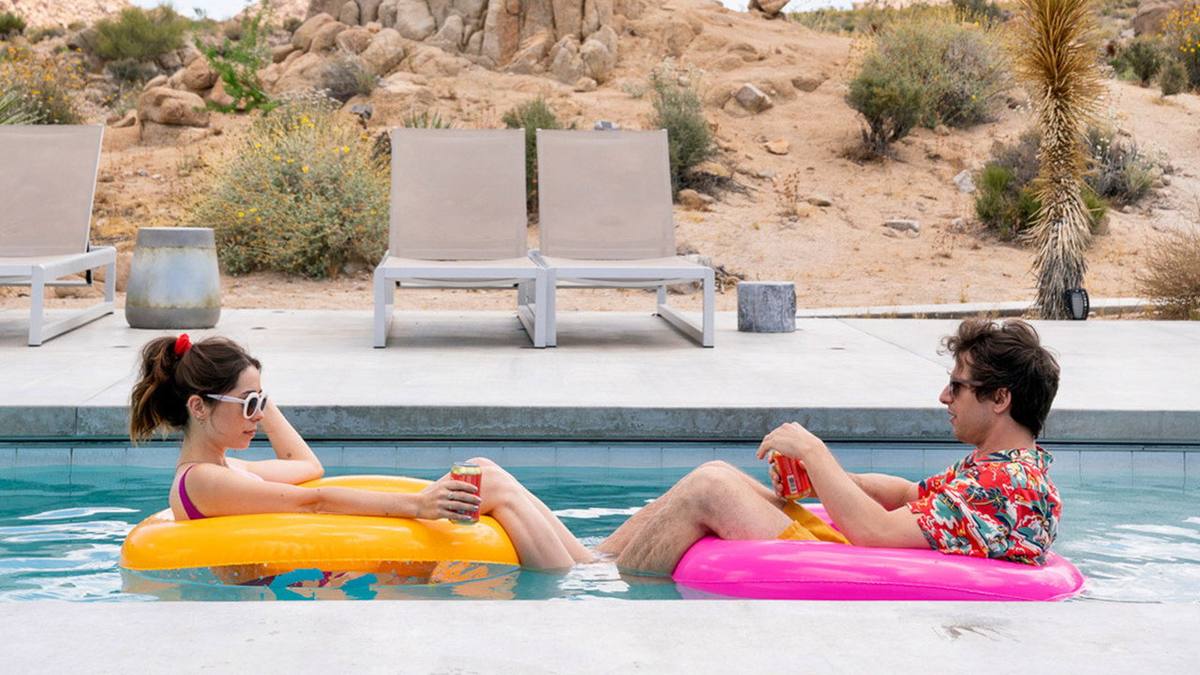
Six months later, when the film premiered digitally in the suffocating depths of July 2020 pandemic lockdowns, Palm Springs felt less like a quirky summer romp and more like a prophetic spiritual lifeline. Audiences trapped inside identical, repeating days suddenly looked up at Andy Samberg floating on a pizza slice raft in a yellow Hawaiian shirt, sipping lukewarm Tala beers, and recognized their own psychological condition.
Yet reducing Palm Springs to an accidental COVID-era metaphor does a grave disservice to its cinematic architecture. By dismantling the moral mechanics of the time-loop subgenre, anchoring its comedy in unapologetic existentialism, and delivering career-best performances from Cristin Milioti and J.K. Simmons, Palm Springs established itself as one of the finest, most rewatchable American comedies of the 21st century.
Here is why this Hulu sci-fi masterpiece continues to resonate so deeply.
Dismantling the Ghost of Groundhog Day
Ever since Harold Ramis and Bill Murray cemented the rules of temporal repetition in 1993’s Groundhog Day, every time-loop movie has operated within a rigid ethical framework: a self-absorbed, cynical jerk is cursed by an ambiguous cosmic referee until he learns empathy, plays the piano, saves lives, and earns romantic redemption. In recent years, genre cinema successfully grafted the concept onto high-concept horror (Happy Death Day) and military action (Edge of Tomorrow).
Palm Springs boldly rejects this entire moral premise.
When the audience meets Nyles (Andy Samberg), he is not on Day One of the curse. He has been trapped at a destination wedding in the desert for so long—thousands of cycles, decades of subjective time—that he cannot remember his former career, his hometown, or whether he was ever married before. He has bypassed the stages of terror, confusion, and godlike exploitation, settling into a state of zen nihilism:
“The only way to really live in this is to accept that nothing matters. We have no choice but to live. So I suggest you surrender to the nothingness.”
By introducing Nyles as an already-exhausted veteran of eternity, the film skips past the predictable exposition tropes and dives straight into the philosophical question: What happens to human morality when tomorrow never arrives?
The Genius of Cristin Milioti’s Sarah
The engine that shatters Nyles’ comfortable purgatory is Sarah Wilder (Cristin Milioti), the bride’s black-sheep older sister who inadvertently follows him into a glowing red cave.
While Nyles represents passive, depressive resignation, Sarah represents ferocious, active rebellion. Milioti’s performance is a whirlwind of self-lacerating guilt, sharp wit, and kinetic physical comedy. Sarah is not a manic pixie dream girl sent to fix Nyles’ broken soul; she is drowning in her own secret shame—having slept with her sister’s fiancé the morning of the wedding, meaning that every time she wakes up, her greatest moral betrayal is reset to square one.
Where Nyles decided that “nothing matters,” Sarah refuses to accept that actions carry zero weight. Her breakthrough comes not from waiting for a magic kiss or an epiphany of universal kindness, but from radical self-education. In one of modern comedy’s greatest subversions, Sarah spends months studying quantum physics, general relativity, and Cauchy horizons via academic textbooks, eventually engineering a controlled explosion to disrupt the loop’s space-time manifold herself.
The romantic chemistry between Samberg and Milioti works because it is rooted in intellectual and emotional parity. In our look at how sketch comedy writing evolved into brilliant character acting, Samberg’s transition from The Lonely Island’s digital absurdist sprints to sustained dramatic pathos finds its ideal emotional anchor in Milioti’s fierce, wide-eyed sincerity.
J.K. Simmons and the Tragedy of Roy
If Nyles represents nihilism and Sarah represents scientific rebellion, J.K. Simmons’ Roy provides Palm Springs with its devastating emotional spine.
Trapped in the loop after Nyles recklessly brought him into the cave during a drug-fueled party, Roy initially spends cycles hunting Nyles across the desert with a compound bow, subjecting him to gruesome acts of vengeance. But when Nyles finally visits Roy at his suburban home outside Irvine, the tone shifts from slapstick retribution to profound domestic heartbreak.
Roy has stopped hunting. He has realized that while eternity preserves his body, it freezes his children at an age where they will never grow up, marry, or live their own lives. In a quiet backyard conversation next to a barbecue grill, Roy tells Nyles:
“I’ve got a good life here. My kids are healthy. My wife still laughs at my jokes. But I’d give anything to see them get older. Don’t waste your time, kid.”
Simmons delivers the line with the weathered gravitas of an Oscar winner, grounding the film’s surreal mechanics in the universal terror of lost time. It is a moment of pure dramatic maturity that elevates Palm Springs far beyond standard studio parody.
The Dance-Floor Scene and Lonely Island DNA
Produced by The Lonely Island (Andy Samberg, Akiva Schaffer, and Jorma Taccone), Palm Springs retains the trio’s signature visual panache and comedic precision while filtering it through cinematic narrative discipline.
The peak of this stylistic synergy arrives during the rehearsal dinner sequence. Having lived through the evening hundreds of times, Nyles and Sarah execute a meticulously synchronized, deadpan dance routine across the crowded reception floor—gliding between clueless bridesmaids, ducking under drink trays, and staring down astonished groomsmen with stone-faced theatrical intensity.
Much like the satirical precision celebrated across the best spoof movies in cinema, the sequence works because it requires virtuoso physical timing. It communicates more about their intimacy, their shared madness, and their unspoken bond than ten minutes of standard romantic dialogue ever could.
The Philosophy: Albert Camus in Swim Trunks
At its philosophical core, Palm Springs is a romanticized staging of Albert Camus’ The Myth of Sisyphus.
Camus famously argued that realizing life has no inherent meaning does not require despair or suicide; rather, one must imagine Sisyphus smiling as he pushes his boulder up the mountain, embracing the struggle as his own.
For years, Nyles chose passive escapism—floating in strangers’ pools, drinking beer, and avoiding emotional attachment because caring about someone creates vulnerability. But when faced with the choice of remaining safe inside an immortal, painless loop or stepping into an explosive quantum gamble where he might die or wake up in an unpredictable world, Nyles chooses risk:
“I’d rather die with you than live this one more day alone.”
The film posits that the real trap was never the glowing cave in the desert; the real trap was emotional detachment. Waking up every day to face aging, bills, disappointment, and eventual death is terrifying—but doing it alongside someone who sees you clearly makes the absurdity of existence worth enduring.
An Instant Classic That Only Improves with Time
Five years after its record-breaking Sundance debut, Palm Springs has aged into a certified modern classic. Its tight 90-minute runtime contains zero narrative bloat, its soundtrack—ranging from Hall & Oates to Genesis and Brazilian psych-rock—is immaculate, and its ending balances ambiguity and optimism with exquisite grace.
In an era where streaming platforms are inundated with disposable, algorithmic content, Palm Springs stands as a glowing reminder of what independent American cinema can achieve when original storytelling, philosophical ambition, and genuine human heart collide under the desert sun.