
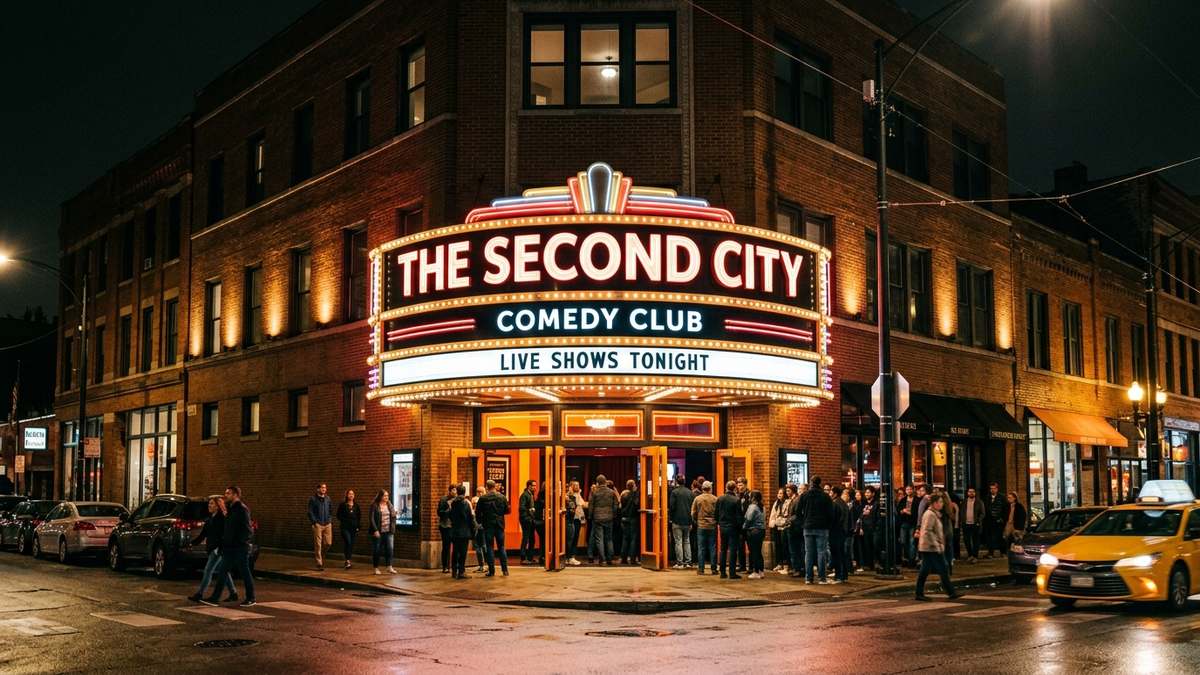
Walk down North Wells Street in Chicago’s Old Town on any given evening, and you will encounter a scene that has remained virtually unbroken for nearly seven decades: crowds bundled in coats beneath an electric marquee, buzzing with anticipation to see six performers step onto an unadorned stage armed with nothing more than six bentwood chairs and an audience suggestion.
That venue is The Second City.
What began on a freezing December night in 1959 as an experimental cabaret theater created by Bernie Sahlins, Paul Sills, and Howard Alk has evolved into The Second City Inc.—a sprawling, globally recognized entertainment empire, conservatory, and corporate training powerhouse. Yet its cultural impact dwarfs even its business footprint.
Without The Second City, modern English-language comedy simply would not exist in its present form. It is the direct artistic cradle of Saturday Night Live, the birthplace of SCTV, the laboratory that refined improvisational theater into an American art form, and the talent crucible that launched John Belushi, Bill Murray, Gilda Radner, Catherine O’Hara, Eugene Levy, Chris Farley, Steve Carell, Stephen Colbert, Tina Fey, Amy Poehler, Keegan-Michael Key, and Vanessa Bayer.
Here is the inside story of how an anti-establishment Chicago stage became the mother church of modern comedy.
The Genesis: Viola Spolin, Del Close, and the Art of “Yes, And”
The artistic DNA of The Second City can be traced to the progressive social movements of early 20th-century Chicago. Viola Spolin, working at Jane Addams’ Hull House, developed a system of theatrical games designed to help immigrant children overcome cultural and linguistic barriers. Spolin recognized that when human beings are focused on solving an active problem within rigid constraints, self-consciousness vanishes and instinctual truth emerges.
Her son, director Paul Sills, took those game mechanics into collegiate theatrical experiments at the University of Chicago, forming the Compass Players alongside David Shepherd, Elaine May, and Mike Nichols. When the Compass disbanded, Sills joined forces with producer Bernie Sahlins and actor Howard Alk to establish a permanent theatrical home on Wells Street.
They christened the theater “The Second City”—a self-deprecating nod to A.J. Liebling’s patronizing 1952 New Yorker profile that derided Chicago as a provincial backwater compared to Manhattan.
THE EVOLUTION OF SECOND CITY IMPROV ARCHITECTURE
==================================================
Viola Spolin (Hull House Theater Games, 1930s-40s)
               │
               ▼
The Compass Players (Nichols & May, Hyde Park, 1955)
               │
               ▼
The Second City (Wells St. Cabaret Founded, Dec 1959)
               │
      ┌────────┴────────┐
      ▼                 ▼
Mainstage & e.t.c.   SCTV / Studio 8H Pipeline
(Chicago / Toronto)  (1975–Present)
Unlike traditional theater, Second City rejected pre-written scripts. Shows were generated through a rigorous, unique rehearsal process: 1. Act I & Act II: A polished, tightly scripted two-act satirical revue. 2. Act III: An unscripted, free-form improvisational set open to audiences who stayed late. 3. The Crucible: The funniest scenes and character dynamics discovered during Act III improvisations were dissected, re-written, and refined the following afternoon, gradually replacing older scenes until an entirely new revue was born.
When visionary guru Del Close returned as resident director in the 1970s and 1980s, he stripped away easy sight gags and demanded truth over punchlines. Close treated improvisation not as an audition tool for conventional acting, but as an existential high-wire act where players served the ensemble with unshakeable commitment.
The Studio 8H Raid: Becoming SNL’s Genetic Foundation
When television producer Lorne Michaels was tasked by NBC with inventing a live late-night variety program in the summer of 1975, he didn’t scout Broadway or Hollywood agent rosters. He boarded a flight to Chicago and Toronto.
Michaels recognized that Second City performers possessed a skill set conventional actors lacked: they were fearless writers who could conceive a topical premise at 4:00 PM and perform it live on air at 11:30 PM without blinking.
The Foundation: From John Belushi and Gilda Radner in Season 1 to modern titans heading into SNL Season 51, Second City alumni remain the lifeblood of Saturday Night Live.
The original Not Ready for Prime Time Players featured Second City Chicago titan John Belushi and Toronto luminaries Dan Aykroyd and Gilda Radner. Bill Murray joined by Season 2.
Meanwhile in Canada, the Toronto Second City cast launched their own legendary television program: SCTV (Second City Television). Armed with comedic masters like Catherine O’Hara, Eugene Levy, John Candy, Harold Ramis, Andrea Martin, and Joe Flaherty, SCTV perfected the meta-satirical television parody that would later inspire everything from The Simpsons to Arrested Development.
The Golden Decades: Generational Waves of Comedy Giants
The Second City is unique among theatrical institutions because its golden eras never stopped happening. Every decade produced a distinct cohort of comedic geniuses who redefined the cultural conversation:
| Era | Key Alumni | Defining Cultural Contributions |
|---|---|---|
| 1960s Pioneers | Alan Arkin, Joan Rivers, Fred Willard, Peter Boyle, Robert Klein | Cabaret satire, counterculture revues, conversational stand-up |
| 1970s Legends | John Belushi, Bill Murray, Dan Aykroyd, Gilda Radner, Harold Ramis, Catherine O’Hara | Saturday Night Live, SCTV, Animal House, Ghostbusters |
| 1980s & 90s Virtuosos | Chris Farley, Mike Myers, Tim Meadows, Steve Carell, Stephen Colbert, Amy Sedaris | Wayne’s World, Tommy Boy, The Daily Show, Strangers with Candy |
| 2000s & 2010s Powerhouses | Tina Fey, Amy Poehler, Keegan-Michael Key, Vanessa Bayer, Tim Robinson, Cecily Strong | 30 Rock, Parks and Recreation, Key & Peele, I Think You Should Leave |
The trajectory of Tina Fey perfectly captures the Second City ethos. Arriving in Chicago in 1992, Fey worked the front desk at a local YMCA while studying improv at night. At Second City, she met lifelong creative partner Amy Poehler and director Jeff Richmond. Fey was eventually scouted by SNL as a writer, quickly becoming the show’s first female head writer before creating the generation-defining satirical sitcom 30 Rock.
The Collegiate Pipeline: From Campus Stage to Second City
The bridge between collegiate satire and Second City has long been one of comedy’s most vital conduits. As highlighted in our retrospective on collegiate sketch comedy and the campus-to-television pipeline, campus revues act as the initial training ground where performers learn ensemble dynamics, musical parodies, and character stamina.
A prime example is Vanessa Bayer. While an undergraduate at the University of Pennsylvania, Bayer honed her satirical timing as a core member of Bloomers, the celebrated all-female musical sketch troupe. Writing and performing sketches in an environment where women commanded every aspect of production gave Bayer an instinct for subverting gendered tropes.
Following her graduation from Penn, Bayer moved directly to Chicago, auditioning her way into The Second City Touring Company and performing on Chicago’s most competitive stages before being hired for Saturday Night Live in 2010. That seamless progression—from collegiate sketch revue to Chicago improv trenches to national broadcast—remains the gold standard for comedic development.
Second City Inc. in the Modern Era: Enterprise and Renaissance
In February 2021, The Second City entered a bold new chapter when private equity firm ZMC (founded by Strauss Zelnick) acquired the institution, officially incorporating as The Second City Inc.
While comedy purists initially greeted the sale with skepticism, the acquisition provided much-needed institutional stability following the devastating impacts of the COVID-19 pandemic on live performing arts.
Today, The Second City Inc. operates across three interlocking divisions: 1. The Theaters: Historic Mainstage and e.t.c. stages in Chicago, alongside dedicated theaters in Toronto and Hollywood, staging original revues year-round. 2. The Training Center: The world’s largest improv conservatory, enrolling over 11,000 students annually across improv, sketch writing, acting, and musical improvisation. 3. Second City Works: A massive B2B corporate consulting division that uses improvisation principles (“Yes, And,” active listening, collaborative agility) to train Fortune 500 executives, medical teams, and creative agencies.
Why The Second City Will Never Be Obsolete
In an era increasingly dominated by algorithmic social media clips, deepfakes, and automated content, live improv comedy feels more radical than ever.
The Second City works because it is fundamentally irreproducible. It is six human beings standing under hot lights in a historic Chicago theater, looking into the eyes of an audience, accepting the reality of the present moment, and creating something hilarious out of thin air that will vanish forever the moment the lights fade to black.
As long as human beings crave the pure, communal electricity of shared laughter, North Wells Street will remain the comedic center of the universe.