
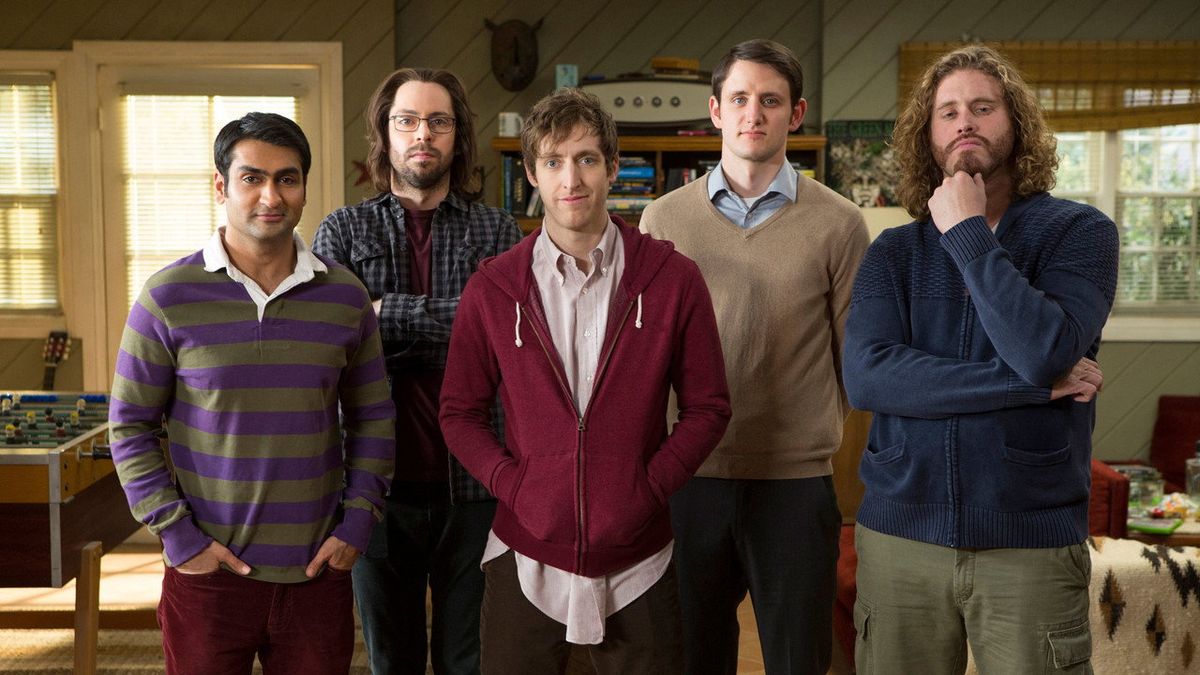
When Mike Judge and Alec Berg created Silicon Valley for HBO in 2014, Northern California’s tech ecosystem was still bathed in utopian mythmaking. Tech founders were routinely lionized as visionary philosophers dedicated to “making the world a better place.”
Judge and Berg saw through the PR veneer. Expanding the cubicle misery and corporate idiocy Judge first skewered in Office Space and modern workplace satire, the series exposed tech culture as an insecure, megalomaniacal circus of unearned billions, vaporware, and social maladjustment.
Yet what transformed Silicon Valley from a clever industry spoof into one of HBO’s greatest comedy series was its extraordinary ensemble.
The actors of Silicon Valley delivered a masterclass in contrasting comedic energies: pairing hyper-verbal arrogance against quiet, terrifying deadpan nihilism. Much like the chemistry we analyzed across The Office cast and the mechanics of deadpan cringe comedy, the show proved that the funniest tech disruptions happen when deeply flawed human beings attempt to build infallible algorithms.
Here is the definitive ranking of the 10 best actors of Silicon Valley, evaluated by comedic performance, character impact, and enduring legacy.
1. Zach Woods — “Donald ‘Jared’ Dunn”
The Role: Jared Dunn, a hyper-polite former Hooli executive whose angelic corporate devotion masked an unspeakably traumatic childhood and a dormant, psychotic street survival instinct.
“How would you like to die today, motherfucker?”
Zach Woods did not merely steal Silicon Valley; he hijacked its soul. Initially conceived as a straight-laced corporate foil who abandons Gavin Belson to manage Pied Piper’s cap table, Jared evolved into modern television’s most fascinating, unpredictable comedic creation.
Woods brought a delicate physical vulnerability to Jared’s six-foot-four frame, speaking in gentle whispers about scrum meetings and pivot tables. But Judge and the writers soon realized Woods’s improv genius: whenever Jared dropped an offhand detail about his Dickensian upbringing (“I was state-raised! You think I’m afraid to catch a case on some bullshit?”), the comedy detonated. From his unhinged sleep-talking in fluent German to threatening venture capitalists with chilling composure, Woods gave a performance of transcendent absurdity.
2. Martin Starr — “Bertram Gilfoyle”
The Role: Bertram Gilfoyle, a Canadian, LaVeyan Satanist systems architect whose monotone disdain for humanity was matched only by his peerless network security genius.
“What do I do? System architecture, networking, and security. No one in this house can touch me on that. But does anyone appreciate that? While you were busy making a fool of yourself, I built a server stack out of trash.”
Having honed his deadpan mastery in Freaks and Geeks and Party Down, Martin Starr delivered the ultimate portrait of the antisocial elite engineer. Gilfoyle possessed absolute clarity about the world: human beings are fundamentally irrational, code is pure, and Dinesh must be destroyed at every opportunity.
Starr never raised his voice, blinked unnecessarily, or smiled. His vocal cadence was flat as a heart monitor, making his philosophical dismissals of capitalism, religion, and office harmony devastatingly funny. Starr’s dry reaction shots anchored the Hacker Hostel’s daily chaos.
3. Kumail Nanjiani — “Dinesh Chugtai”
The Role: Dinesh Chugtai, a brilliant Java programmer whose crippling social insecurity, desperate vanity, and lust for Silicon Valley status repeatedly orchestrated his own downfall.
The adversarial brotherly dynamic between Kumail Nanjiani’s Dinesh and Martin Starr’s Gilfoyle provided Silicon Valley with its most reliable engine of pure comedy. While Gilfoyle operated with supreme confidence, Dinesh was hopelessly fragile.
Every time Dinesh achieved an ounce of success—buying a gaudy gold chain, leasing an electric supercar he couldn’t drive, or being appointed temporary CEO—Nanjiani’s puffed-up arrogance collapsed into agonizing humiliation within minutes. Nanjiani’s expressive eyes and stammering vocal defenses turned petty workplace jealousy into high art, launching him into a Hollywood leading-man career.
4. T.J. Miller — “Erlich Bachman”
The Role: Erlich Bachman, the kimono-wearing, bong-smoking landlord whose tech incubator was built on the unearned proceeds of selling his aviation startup, Aviato.
“You just brought piss to a shit fight!”
During the show’s first four seasons, T.J. Miller served as Silicon Valley’s wrecking ball. Erlich was the personification of the tech bro’s unearned hubris: a man with mediocre programming skills who believed his sheer verbal aggression and Silicon Valley buzzwords entitled him to ten percent of every company founded under his roof.
Miller’s command of baroque, pseudo-intellectual insult language was peerless. Whether slapping a neighborhood child over Adderall, physically purging Jian-Yang’s kitchen, or negging prestigious venture capital firms by placing his shoes on their boardroom mahogany, Miller supplied the series with pure, explosive momentum.
5. Matt Ross — “Gavin Belson”
The Role: Gavin Belson, the billionaire CEO of tech titan Hooli who dressed corporate greed and anti-competitive monopolies in the language of Buddhist enlightenment and cosmic charity.
“I don’t know about you people, but I don’t want to live in a world where someone else makes the world a better place better than we do.”
Matt Ross gave the definitive satirical performance of the 21st-century tech oligarch. Amalgamating the philosophical narcissism of Steve Jobs, Marc Benioff, and Larry Page, Ross played Belson with terrifying conviction.
His corporate demonstrations—bringing actual bulldogs, tortoises, and bears into boardrooms to illustrate business metaphors that baffled his executives—are modern satire at its finest. Ross never played Gavin as an evil cartoon; he played him as a man who genuinely believed his own quarterly profits were directly aligned with the spiritual evolution of humanity.
6. Thomas Middleditch — “Richard Hendricks”
The Role: Richard Hendricks, a compression-algorithm genius whose paralyzing anxiety, gastrointestinal stress, and moral vanity made leading a company an existential crisis.
Carrying a serialized comedy about lossless compression requires an actor capable of making technical engineering feel like high-stakes drama. Thomas Middleditch grounded Richard Hendricks with breathless, sweating physical comedy.
Middleditch excelled at the sudden panic attack, hyperventilating into brown paper bags or vomiting into trash cans before major venture pitches. Yet his performance was brilliant because Richard was not an innocent victim; as the seasons progressed, Middleditch exposed Richard’s stubborn ego and petty ruthlessness, demonstrating how tech founders compromise their principles one byte at a time.
7. Josh Brener — “Nelson ‘Big Head’ Bighetti”
The Role: Big Head, a hopelessly unqualified coder who fails upward through corporate politics, accumulating executive titles, tens of millions of dollars, and Stanford professorships entirely by mistake.
Josh Brener provided the show’s sharpest commentary on the arbitrary nature of Silicon Valley wealth. Big Head never understood what Hooli was building, spent his days drinking Big Gulps on the corporate roof with the “rest and vest” crew, and yet was promoted repeatedly simply because executive rivals wanted to use him as a political pawn.
Brener played Big Head with endearing, guileless innocence. While Richard and Dinesh tortured themselves trying to change the world, Big Head drifted cheerfully through life, proving that in a bubble economy, complete incompetence can be a lucrative strategy.
8. Suzanne Cryer — “Laurie Bream”
The Role: Laurie Bream, a venture capitalist who evaluated human beings, companies, and morality with the clinical, unfeeling speed of a supercomputer processor.
Stepping in after the tragic passing of Christopher Evan Welch (who played the brilliant Peter Gregory in Season 1), Suzanne Cryer accomplished the impossible: creating a distinct, unforgettable venture capital archetype.
Laurie Bream communicated entirely without social pleasantries or emotional modulation. Her staccato pauses, awkward hand gestures, and ruthless mathematical pragmatism (“I have no feelings on this matter, Richard. I am an investor. Numbers do not experience emotional remorse”) made her every boardroom appearance a masterclass in dry comic tension.
9. Amanda Crew — “Monica Hall”
The Role: Monica Hall, an associate partner at Raviga Capital who repeatedly risked her career standing to protect Pied Piper from predatory venture capitalists and corporate sharks.
In a cast populated by egomaniacs and eccentrics, Amanda Crew had the most difficult job: playing the emotional and professional anchor. As Monica, Crew was the only person in the room who possessed both high business intelligence and basic ethical standards.
Crew played Monica with sharp wit and subtle cynicism, rolling her eyes at tech-bro jargon while outmaneuvering cutthroat board members. Her evolution into Pied Piper’s CFO gave the back-half of the series a steady, confident core.
10. Stephen Tobolowsky — “Jack ‘Action Jack’ Barker”
The Role: Action Jack Barker, the veteran turnaround CEO brought in by Raviga to replace Richard, who immediately shelved Pied Piper's revolutionary algorithm to manufacture a beige enterprise server box.
Few character actors can weaponize genial suburban charm quite like Stephen Tobolowsky. Arriving in Season 3 as the seasoned adult in the room, Action Jack Barker represented the soulless enterprise establishment that buys startups and guts their vision.
Tobolowsky’s delivery of corporate platitudes about “the conjoined triangles of success” and his folksy enthusiasm for high-margin enterprise storage racks perfectly captured the eternal war between Silicon Valley engineering purists and old-money salespeople.
The Legacy of Mike Judge’s Tech Ensemble
More than a decade after Pied Piper first compressed its first file in Erlich Bachman’s garage, Silicon Valley stands as the definitive comedic document of the mobile and cloud era. The actors of Silicon Valley didn’t merely satirize tech; they anticipated the bizarre trajectory of 21st-century tech culture—from crypto hype and pivot culture to artificial intelligence megalomania.
By treating the absurdities of venture capital with the same tragicomic dignity that the greatest sketch and improv ensembles brought to television, this cast captured lightning in a server rack. In a world full of people trying to “make the world a better place,” these actors made it incomparably funnier.